This post is a collection of images created by the celebrated English woman painter Evelyn de Morgan (1855 – 1919). The Pre-Raphaelites Brotherhood in England which sought the revival of Renaisance Italian art had disbanded in 1854, 1 year before Evelyn’s birth but the movement continued and she was involved in the latter part. Her style was influenced by early Italian Renaissance masters like Sandro Botticelli and English Pre-Raphaelites such as Edward Burne-Jones. Her style also incorporated elements of classical drapery, theatrical posing, and vibrant, jewel-toned color palettes.
This site attempts to make apparent the beauty hidden in images thru the site’s image scrolling function.
Choose an image and click. It will expand and scroll view. You can click control tabs on the upper left corner of the screen. Depending on the tab, you can (1)fast scroll (skip button), (2)expand, (3)minimize, (4)shift right or left, (5)pause or (6)scroll up or down. You will see details not noticed in normal viewing. This will reveal beauty hidden from you before.
Some comments by the administrator of this site have been added. we believe a painting is more enjoyable when a person unders tands some of the history and circumstances behind each painting. Enjoy !
The life of Evelyn de Morgan
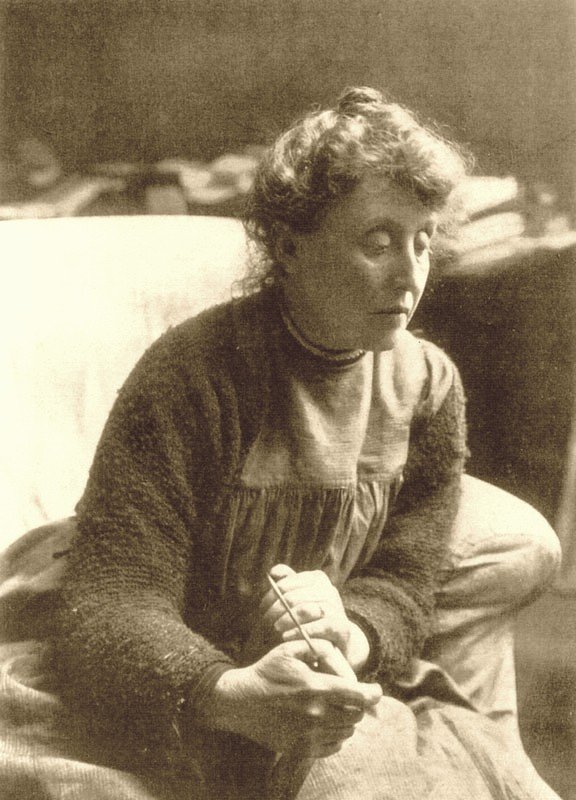

Evelyn De Morgan (born Mary Evelyn Pickering; 1855 – 1919) was a pioneering English painter associated with the Pre-Raphaelite Brotherhood, Aestheticism, and Symbolism. Working in a male-dominated Victorian art world, she used her art to express her values, which included feminism, pacifism, and spiritualism.
Childhood
She was born into an wealthy, upper-class family in London, Evelyn was the daughter of Percival Pickering, a prominent Queen’s Counsel, and Anna Maria Wilhelmina Spencer-Stanhope. The eldest of four.
While most Victorian girls were trained in domestic accomplishments, Evelyn’s mother insisted she receive the same education as her brothers. De Morgan became precocious, with an excellent education in mathematics, Latin, Greek, French, German, Italian. She also studied classical literature, mythology. She was devoted to art from an early age. Here is an excerp from a diary by 17 years old Evelyn, “Art is eternal, but life is short…” — “I will make up for it now, I have not a moment to lose.” In 1872, she enrolled at the South Kensington National Art Training School, in 1873 moved to the prestigious Slade School of Art. At Slade, in her first year she won a full scholarship, then went on to win numerous awards: the Prize and Silver Medal for Painting from the Antique, etc.. She also attended physical anatomy lessons which were usually reserved for men. A very unconventional and revolutionary practice for a Victorian women. This served to improved her grasp of the human form and her paintings became robust, believable, lifelike.
Marriage
In 1883, Evelyn met William De Morgan, a brilliant Arts and Crafts ceramicist, potter, and designer who was 16 years her senior. They married on March 5, 1887. For decades, William’s pottery business struggled financially and Evelyn selflessly used the profits from her own successful painting sales to keep his kilns running. The couple only achieved financial security in 1906 when William found unexpected success as a novelist.
The Botticelli influence
The couple sought relief from London winters and inspiration from the Italian Renaissance and spent half of every year in Florence, Italy, from 1895 until the outbreak of World War I in 1914. There, Evelyn fell in love with the Early Renaissance style of Sandro Botticelli. This transformed her use of light, drapery, and allegorical figures. The Botticelli influence can be seen in Evelyn’s masterpiece “Flora” which can be likened to Botticelli’s “Primavera” and “The Birth of Venus”.
Women’s rights
Women’s rights were severely curtailed in Victorian England. In her youth Evelyn had had to fight many battles to become an artist, even her mother trying to sabotage her artistic ambitions saying she wanted “a daughter, not an artist”; meaning it was not a woman’s place to become an artist. However she had help. Her maternal uncle, the Pre-Raphaelite painter John Roddam Spencer Stanhope, recognized her immense talent and mentored her. Thus in her latter years she supported women’s right to vote and signed the 1889 Declaration in Favour of Women’s Suffrage. This is reflected in her art which constantly placed strong, highly expressive women at the center of mythological and spiritual narratives, such as Clytie (1877) . Cadmus and Harmonia (1898), The Crown of Glory (circa 1896) etc..
Spiritualism
Evelyn and William were both deeply committed Spiritualists and regularly practiced automatic writing (communicating with spirits via a guided pen). Her paintings became visual maps of her theology, focusing on the journey of the human soul, the transition from death to afterlife, and the interplay between light and dark.Some notable paintings are Naomi and Ruth (1887), The Soul’s Prison House (1880) and The Cadence of Autumn (1905).
Pacifism
She was horrified by the horrors of the Boer Wars (1880–1881 and 1899–1902) and and World War I (1914-1918) and dedicated her later career to painting haunting, anti-war allegories (often depicting war as a terrifying demon or a dark wasteland). Some notable paintings in this direction are S.O.S (1914-1916) and Lux in Tenebris (circa 1895).
Death and Legacy
William passed away in 1917, and Evelyn died just two years later on May 2, 1919, in London, shortly after completing a headstone monument for her husband. Though her name was occasionally overshadowed by her husband’s ceramic fame in the mid-20th century, her sister, Anna Wilhelmina Stirling, fought to preserve her artistic memory. In 1965 Wilhelmina established The De Morgan Foundation and today, the vast majority of her rich artistic output is managed and exhibited by it. It celebrates her as a major force of late-Victorian symbolism and a pioneer for women in the fine arts.
The Mythological De Morgan
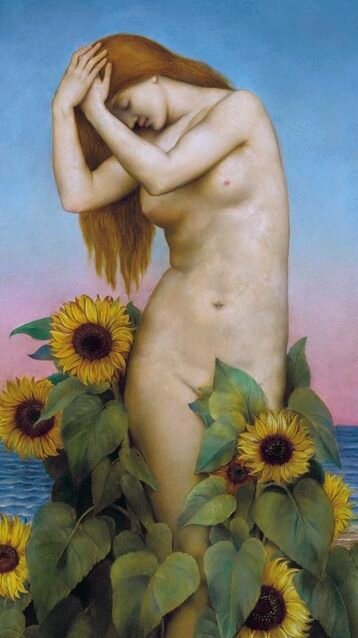
- Clytie (1877) → the woman who became a sunflower click for more info
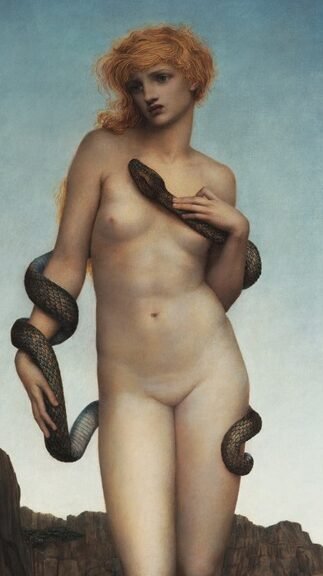
- Cadmus and Harmonia (1898) → the woman who became a serpent click for more info
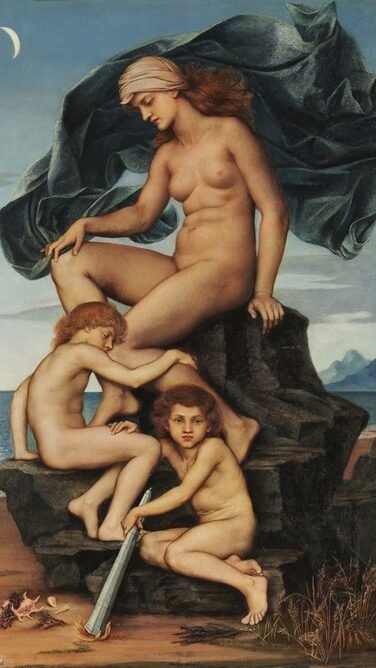
- Sleep and Death, the Children of the Night (1883) → the eternal circle of life click for more info
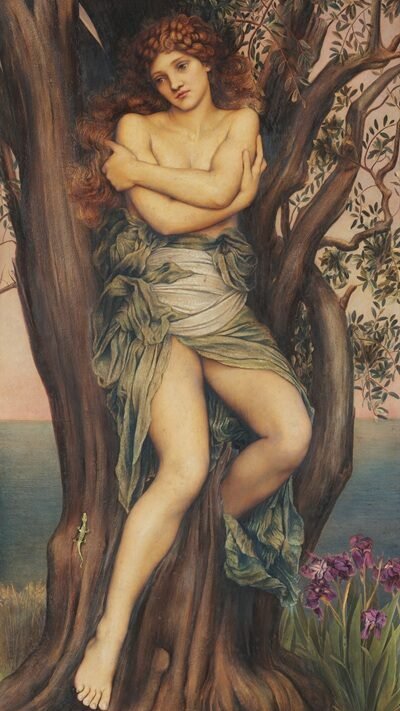
- The Dryad (from 1884 until 1885) → dependence versus freedom click for more info
This painting portrays the mythological water nymph Clytie from 8 CE Roman poet Ovid’s Metamorphoses,
The story : Clytie is a water nymph. She loved the sun god Apollo but he abandoned her. In despair, she sat on the earth watching his sun chariot cross the sky every day. In the end her limbs transformed into roots and she turned into a sunflower that perpetually followed the light. Eternal devotion in a lovely woman.
De Morgan uses the mythological female figure to explore themes of interior life, devotion, and spiritual transformation.

Cadmus and Harmonia is a 1877 oil-on-canvas mythological painting by De Morgan. The original storyline was created by Roman poet Ovid. Metamorphoses (Book IV, 563-603).
The story : Cadmus (the founder and first king of Thebes) is turned into a serpent by Mars the god of war, His faithful wife Harmonia begs the gods for the same fate so they can remain together.
The depiction : In the painting Harmonia stands against a rocky mountain in a contrapposto stance, embraced and protectively encircled by her serpent husband.
De Morgan cleverly explores the themes of devotion and spiritual transformation using a mythological female figure.

Sleep and Death, the Children of the Night by De Morgan.
The depiction : The woman in the center is Nyx, a Greek goddess, personification of night. She was one of the first beings to emerge from the void of Chaos. One of her offsprings Hypnos (Sleep) rests calmly against the lady’s knee. Another offspring Thanatos (Death) stares out of the canvas, holding an extinguished torch as a symbol for the end of the life.
In this painting De Morgan explores mortality, the cyclical nature of rest and the end of life. Here death is not a fearful thing but a peaceful transition of the spirit. Also De Morgan portrays women not as passive or vulnerable ornaments, but as active, powerful mother figures directing the spiritual world.
.jpg)
The Dryad is an 1885 oil-on-panel painting by De Morgan. A mythological tree nymph is emerging from an oak trunk.
The depiction : In the center is a tender, wistful, soft young woman. There is vulnerability in her eyes and pose, in the way her arms are crossed over her bosom, as if she is hiding herself, protecting herself from someone’s gaze, someone’s hand. The woman is a tree nymph. Her life is tied to the tree. If the tree dies, she dies. If she strays far from the tree she dies. Yet she is blessed. A crawling lizard at her feet signifies renewal and eternal life. The purple irises at her feet represent the goddess Iris (messenger of the gods and personification of rainbows that nourish nature), She is rooted but she lives. The tree is protective, its branches surround and embrace the fragile nymph like a sheltering father.
Meaning :De Morgan transforms mythological imagery into a meditation on emotional and social confinement. Because the woman cannot seperate from the tree, there is dependence, rootedness, and vulnerability. Yet the trees symbolize life, endurance, growth and fatherly love.
The model :The model is Jane Hales. She originally worked as a nursery maid for the artist’s family before becoming her personal maid and model.

The Women of Evelyn De Morgan
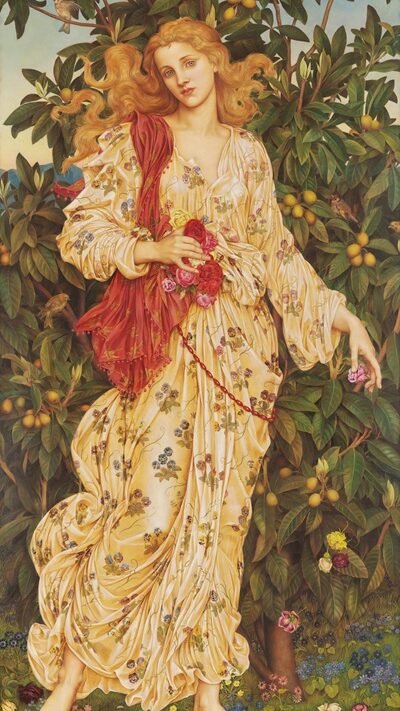
- Flora (1894)→The woman goddess who symbolizes spring click for more info
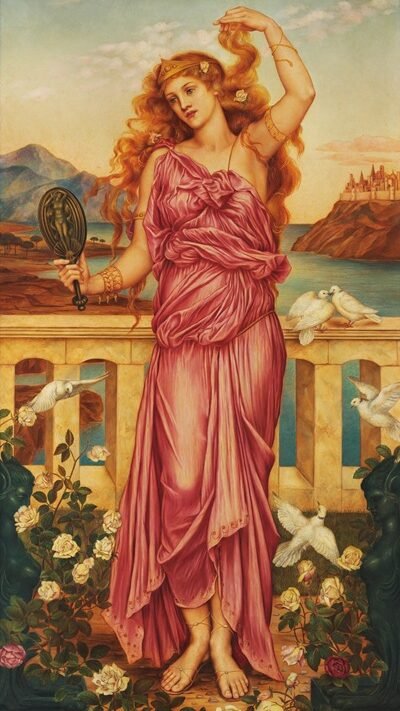
- Helen of Troy (1898)→ The innocent woman Helen of Troy click for more info
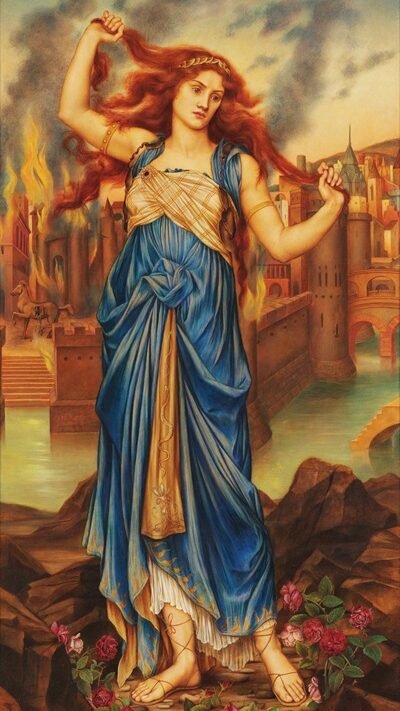
- Cassandra (1898) → The Oracle no one believed click for more info
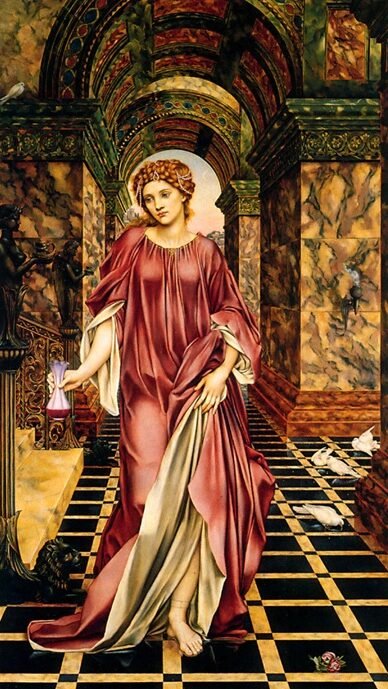
- Medea (1889) → the troubled woman click for more info
Flora is a renowned 1894 oil on canvas painting by De Morgan. Considered one of her best works,
De Morgan is a symbolist, not a story teller, so this is only a depiction : Flora is the Roman goddess of flowers, vegetation and fertility – therefore the goddess of Spring. In the old days the Romans had a festival in honour of Flora. It was from late April to early May and was called Floralia. In present day Britain the rites survives as the celebration of the May Queen. In the painting Flora is dressed as a Florentine bride. She wears a white robe with Florentine flowers patterns, draped over gold leaf that shines through the pigment. Scattered blossoms and spring flowers, yellow primroses and blue forget-me-nots at her feet provide accent. She is beautiful and she symbolizes spring.
Influences : The painting is inspired by Italian Renaissance masters — Sandro Botticelli’s Primavera and The Birth of Venus. De Morgan painted it entirely in Florence.

Helen of Troy is an 1898 oil-on-canvas painting by De Morgan.
Classical art often depicts Helen as the woman instigator who caused the launching of a thousand ships for her beauty. Here De Morgan flips the narative. She paints Helen as an innocent maiden, young and beautiful with a saintly air, a sinless victim of male ambition. In her hand is the Mirror of Aphrodite, the goddess of Love. She only loved. She instigated nothing. The white doves arround her are symbols of peace and purity. The white roses at her feet pay homage to Aphrodite. Their soft tones match her pink mantles, signaling girlish innocence and love. That is the message.

The Crown of Glory is an oil-on-canvas painting created circa 1896 by De Morgan
Meaning : De Morgan portrays “glory” not as a worldly or material conquest, but as a deeply internal, spiritual act. The figure embodies purity, sacrifice, and the soul’s invisible, divine reward.
The painting in the background subtly references the mystical marriage of Saint Francis of Assisi to Lady Poverty, reinforcing themes of rejecting earthly wealth for a higher spiritual calling.
Cultural background : De Morgan was subtly advocating the independence of women in this painting. The late 1800s, the period when this painting was published, marked a crucial turning point in England where women claimed economic, social, and physical freedom. The following are some milestones.
The milestones: (1) The Married Women’s Property Act (1882), (2) 1891 High Court ruling established that a husband could no longer legally kidnap or imprison his wife to force her to live with him, vastly increasing a woman’s personal autonomy within marriage, (3) In 1898, Ethel Charles became the first woman to qualify as an architect in Britain, breaching a massive professional barrier., (4) Lilian Lindsay became the first British woman to qualify as a dentist in 1895, and universities like the University of London had begun awarding full degrees to women.

Medea by De Morgan
The story : In Greek myth, Medea is the daughter of King Aeëtes of Colchis. In most stories she is a sorceress, and is often depicted as a high priestess of the goddess Hecate. In the myth of the Argonauts, she uses her magic and aids Jason in his search for the Golden Fleece. Once he finishes his quest, she abandons her native home of Colchis and goes westwards with Jason and eventually settle in Corinth and marry. Ten years of happy married life ensures. Then Jason decides to abandon her to wed King Creon’s daughter Creusa. Medea is exiled from Corinth by Creon. In revenge, Medea murders her own sons and Jason’s new bride. Jason is left without heir and legacy for the rest of his life. Medea is a villainous woman.
De Morgan challenges the above narative. The painting is filled with symbols which hint that the painter blames Medea’s turmoil and mental torment on the deceit of Jason of the Argonauts. He won Medea’s assistance in obtaining the Golden Fleece and married her, but later betrayed her, leading her into committing acts of vengeance, including the murder of her rival and her own children. In the classical tradition, Medea was often cast as a malevolent force, driven to unspeakable acts of violence. De Morgan’s interpretation challenges this stereotype, portraying her as a tragic figure rather than a heartless killer. The sumptuous Rose Madder gown draping Medea, chosen deliberately by the artist, symbolizes a range of emotions, from sadness and strength to regality and purity. This suggests that De Morgan saw Medea not as a heartless villain but as a character driven by complex motivations. Her actions, including the murder of her romantic rival and her own children, can be reinterpreted through the lens of despair and desperation rather than her killing in cold blood. The small details within the painting offer further insights into De Morgan’s perspective. The doves on the floor, often associated with peace and innocence, may reflect De Morgan’s view that Medea is not acting with malice. The extinguished lamps, emitting minimal smoke, symbolize the impending doom and the passage of time as Medea grapples with her dark thoughts. The presence of black marble in the opus sectile flooring is a subtle indicator of grief.
In 1889, De Morgan signed the Declaration in Favour of Women’s Suffrage, publicly presenting herself as a feminist and advocate for gender equality. However. De Morgan did not actively support the movement. She chose to support it through her paintings. Thus De Morgan shows a deep understanding for the deep psychological impact that deceitful behaviour could have on silenced women who could not speak out in both ancient and her own times. Her Medea is a complex and multifaceted character who was betrayed by her husband. This highlights the emotional turmoil and sociial pressures that may have driven Medea to commit unspeakable acts.

Spiritual De Morgan
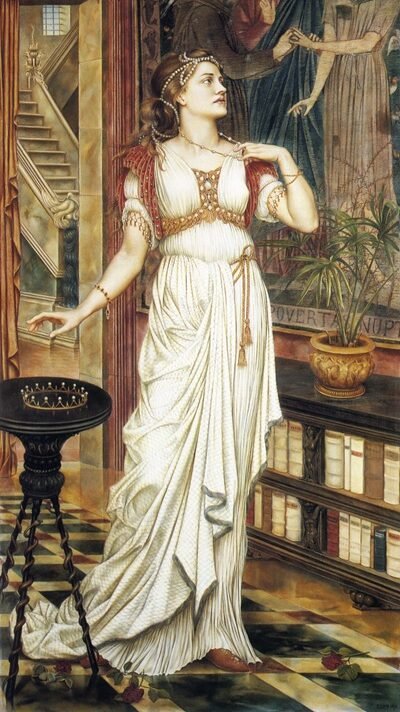
- The Crown of Glory (circa 1896) → The woman who embodies purity and sacrifice click for more info
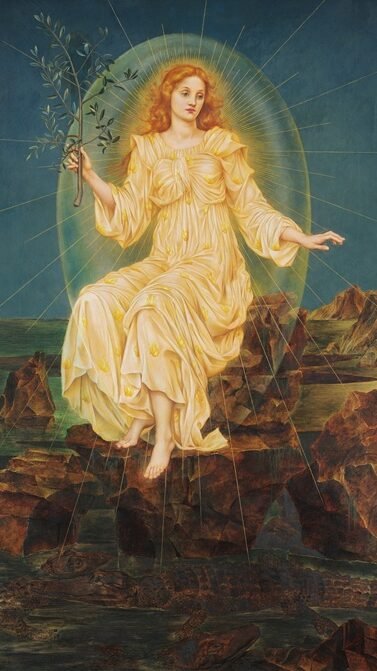
- Lux in Tenebris (circa 1895)→ Light in Darkness click for more info
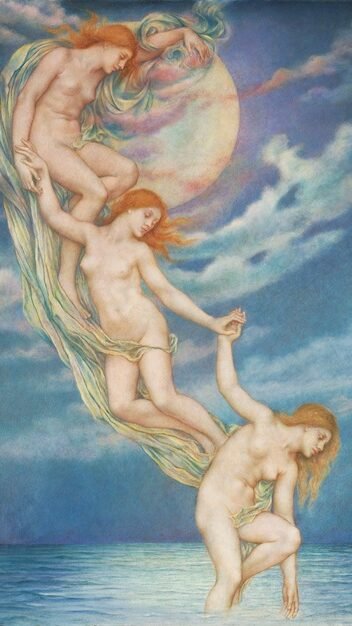
- Moonbeams Dipping Into The Sea (1918) → Three women connect moon and earth click for more info.
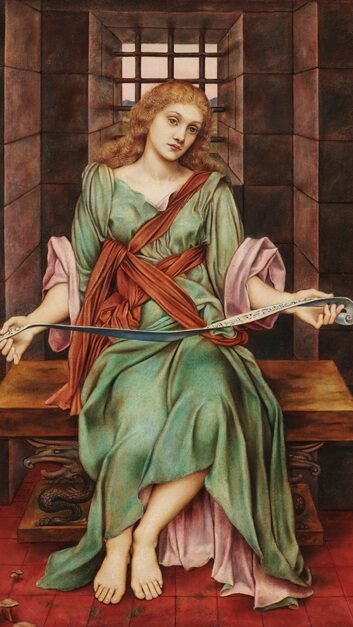
- The Soul’s Prison House (1880) → Lovely prisoner in her cell click for more info
Casandra an 1898 oil-on-canvas painting by De Morgan
The painting depicts Cassandra, the daughter of King Priam and Queen Hecuba of Troy. The sun god Apollo fell in love with her and gifted her the power of prophecy in exchange for her affection. But Cassandra ultimately rejected him. Apollo cursed her so that her predictions—while entirely accurate—would never be believed.
In the painting De Morgan portrays Cassandra against the backdrop of a burning Troy. The Trojan horse stands near the gates. Her prophecies were correct but ignored. You see the tragic frustration of a woman who foresaw the city’s destruction yet was dismissed as insane. The deep red flowers at her feet foreshadow the impending slaughter of her people.
De Morgan was a supporter of women’s rights, Art historians note that Cassandra acts as an artistic proxy for the late-Victorian feminist movement. Cassandra’s struggle represents the broader frustration of women in the 19th and early 20th centuries, whose intellect, warnings, and political voices were systematically ignored and dismissed.

Lux in Tenebris is an 1895 oil-on-canvas painting by De Morgan. The Latin title translates to “Light in Darkness,” a reference to the Gospel of John: “The light shines in the darkness, and the darkness has not overcome it”.
The luminous woman in the center is a personification of light, goodness, hope, and peace. She is clad in a radiant yellow gown adorned with tiny gold leaf flames. A laurel/olive branch makes the pacifist message of peace explicit. At the base of the painting, crocodiles and monsters prowl the murky water. These creatures are being banished by the shining light.
The painting reflects De Morgan’s involvement in Spiritualism. This she shared with her husband, William De Morgan, and her mother-in-law, Sophia De Morgan. It was a cosmic battle between good and evil.

Moonbeams Dipping Into The Sea is a 1918 painting by De Morgan
The painting depicts three ethereal, nude female figures who represent moonbeams. Holding hands and entwined in diaphanous fabric, they form a human chain reaching down from a crescent moon in a twilight sky to the calm surface of the sea.
In ancient lore, the moon is often represented by a “triple goddess” split into three stages of life: maiden, mother, and crone. De Morgan deliberately subverted this by making all three figures beautiful, radiant young women.
Heavily influenced by Spiritualism, De Morgan used the figures to represent the progression of the soul. The female moonbeams serve as a literal link connecting the earthly boundaries of the water to the heavenly realm of the moon.
De Morgan died in 1919, so this is one of her last works. Her husband had died in 1917 and it is said that she was very lonely. A divergence is noticeable between works produced during this last phase and the joyous beauty of her earlier works. There is a note of tragedy in her work.

The Soul’s Prison House is a prominent allegorical painting created in 1880 painting by De Morgan.
The painting is a visual representation of De Morgan’s Spiritualist beliefs. It taught that the physical body is just a temporary earthly shell—an encumbrance—which the human spirit inherently longs to discard at death in order to ascend into a higher spiritual state.
In the painting the woman inside represents the human Soul. It is trapped inside a dark cell that symbolizes the mortal body. She looks out of the window toward the light outside, eagerly awaiting the release of death.
De Morgan held deep Spiritualist beliefs. Her husband William De Morgan a famous ceramicist and novelist—shared her fascination with the afterlife. Her mother-in-law Sophia De Morgan was a prominent clairvoyant, psychic healer, and Spiritualist writer.
The Core Spiritual Tenets were
(1) Survival of the Soul: She believed the human soul continues its moral and spiritual progression after physical death rather than ending at the grave. (2) Rejection of Materialism: She viewed worldly greed, hoarded wealth, and materialism as spiritual imprisonment that blinds the soul to higher truth.
In her paintings De Morgan used prismatic colors and piercing beams of light as symbols of hope, divine truth, and the soul’s triumph over darkness.

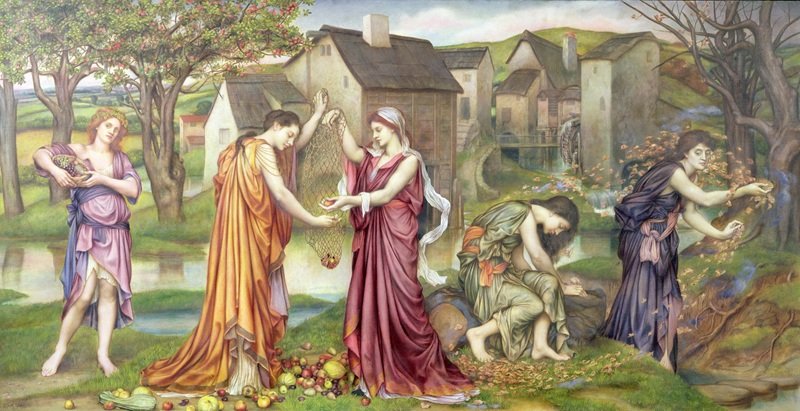
The Cadence of Autumn (1905) → The cycle of life and the 4 seasons click for more info
The Cadence of Autumn is a prominent 1905 oil-on-canvas painting by De Morgan.
In music, a cadence marks the conclusion of a musical phrase. De Morgan uses this concept to represent the natural winding down of life. Painted when she was 50 years old, the work reflects her preoccupation with her own aging process and mortality.
Allegory of the Seasons : The flow of the painting moves from left to right, charting both seasonal changes and the human lifecycle. Spring (Left) : A young woman in vibrant lilac/mauve robes stands amidst green, fruit-bearing trees and ripe cornfields. This symbolizes youth, gaiety, and birth. Summer (Center): Two central figures harvest an abundance of fruit (apples, pears, and marrows) into a large net bag. This captures the peak of life and plenty. Autumn & Winter (Right): The colors shift to muted, somber tones. An older woman crouches down grasping dying leaves, while the final figure stands in black robes, letting dead leaves scatter into the wind. The background transitions to barren trees and a chilly, hilly landscape, illustrating the descent into old age and death.
However death was not an absolute for De Morgan. She was a Spiritualist and believed in life after death, the existance of the eternal soul. So this painting is statement of redemptive hope, rebirth after death.

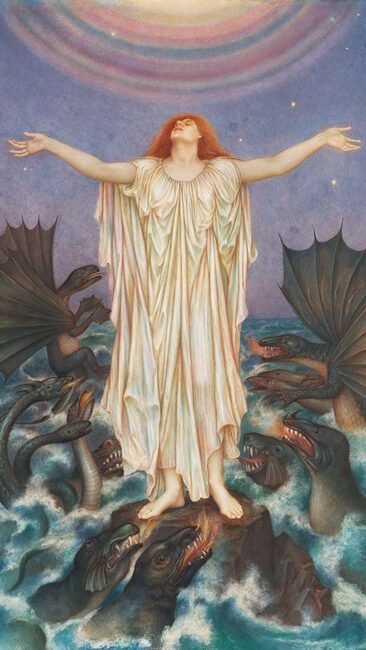
- S.O.S (1914-1916) → reaching for heaven click for more info
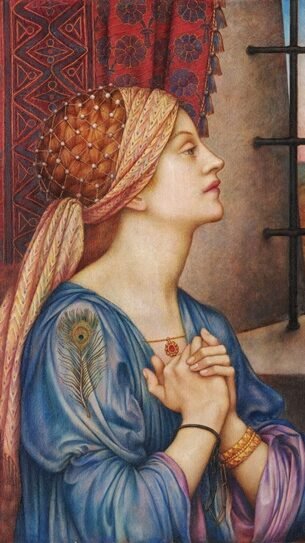
- The Prisoner (between 1907 and 1908) → release from a prison of the soul click for more info
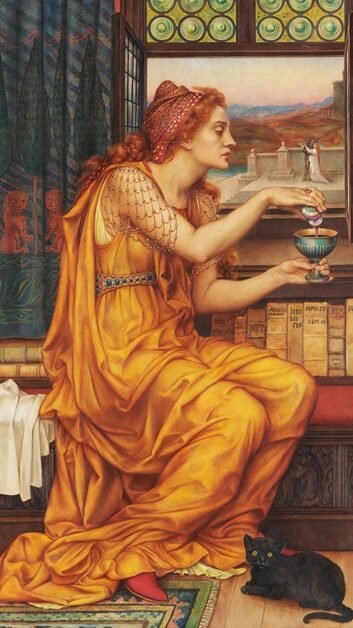
- The Love Potion (1903) → the inner soul of a studious woman click for more info
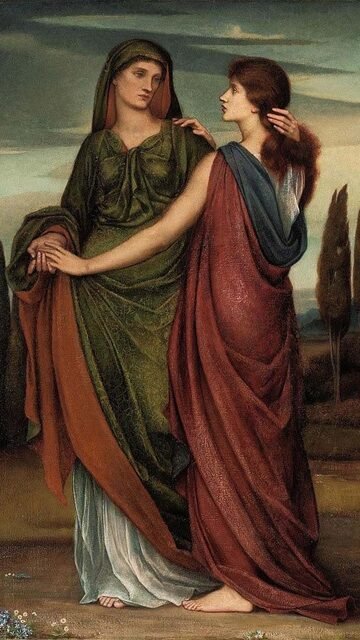
- Naomi and Ruth (1887) → loyalty between mother and daughter click for more info
Studies by De Morgan
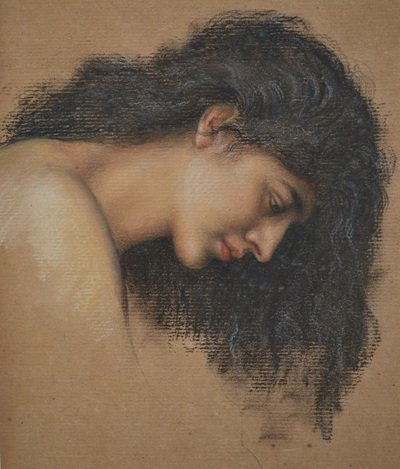
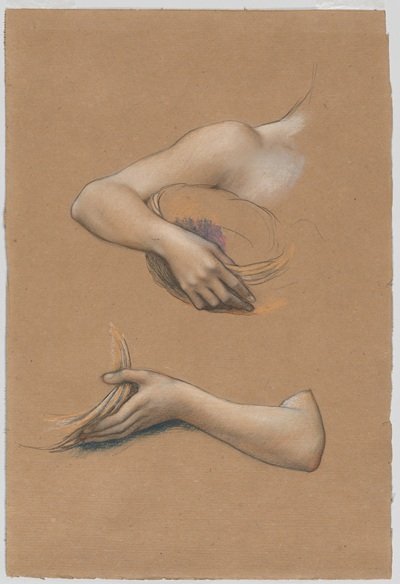
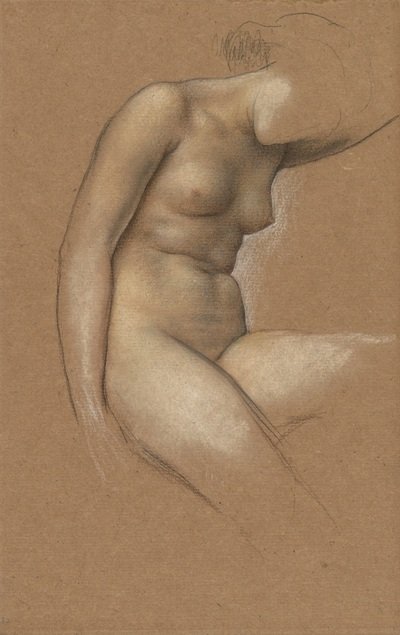
Beautiful female form studies by De Morgan which clearly show her artistic skills.
S.O.S. is a symbolic oil-on-canvas painting created by Symbolist artist De Morgan between 1914 and 1916. Painted during World War I, the piece functions as a powerful, pacifist critique of the horror and futility of war.
The Title: Takes its name from the Morse code distress signal (“Save Our Souls”), which was relatively new at the time. De Morgan used it to frame the spiritual and physical stakes of global conflict
The Central Figure: A lone woman dressed in flowing white robes stands on a small, solitary rock. She represents the innocent victims of war, with her arms outstretched and eyes turned toward heaven in a desperate plea for deliverance.
The Monsters: The woman is besieged by turbulent, crashing waves, sea serpents, and dragons. In De Morgan’s symbolist lexicon, these creatures represent evil, torment, and death
The Rainbow: Near the top of the canvas, a rainbow breaks through the darkness. This serves as a vital symbol of hope, spiritual salvation, and the afterlife, reflecting De Morgan’s deep personal commitment to Spiritualism.
De Morgan was politically engaged—she supported women’s suffrage and was a pacifist. S.O.S. is one of over fifteen war paintings she produced during the Boer War and World War I.
.jpg)
The Prisoner is an oil-on-canvas painting completed between 1907 and 1908 by Pre-Raphaelite and Symbolist artist Evelyn De Morgan.
The painting portrays a solitary woman confined within a dark cell, looking longingly toward a window that lets in a sliver of natural light. De Morgan used several key symbolic details to convey the painting’s deeper meaning
The Dress and Peacock Feather: The woman wears a luxurious blue dress adorned with a peacock feather, which is a traditional art historical symbol of immortality and the incorruptible soul.
The Shackle and Bracelet: Her wrists are bound by chains. On one wrist, she wears a heavy iron shackle; however, on the other wrist, the chain seamlessly blends into a golden bracelet, representing how earthly attachments and physical existence bound the spirit.
The Light: Natural light sits at the threshold of the window, remaining just out of reach to serve as a beacon for what lies beyond physical confinemen
The painting functions as a Spiritualist allegory of the human soul. De Morgan was committed Spiritualism, and believed the physical body was merely a temporary, earthly shell—an encumbrance that the spirit longs to shed. In The Prisoner, the dungeon represents the mortal body, while the window and light represent the inevitable release of death, allowing the soul to ascend into spiritual immortality.
The creation of The Prisoner coincided with a turning point in De Morgan’s life. Around 1907, her husband William achieved massive commercial success as a bestselling novelist. This success freed De Morgan from the bond of art patrons or market trends. She could spend the final stages of her life focusing completely on personal, mystical, and allegorical subjects.

The Love Potion is a 1903 oil on canvas painting by De Morgan. It features the famous Pre-Raphaelite muse Jane Morris as model. It explores allegorical themes regarding the soul’s progression toward spiritual enlightenment.
The painting portrays a studious woman working to produce a portion. There are some key symbolic that convey the painting’s deeper meaning.
The woman in pursuit of knowledge: Bookshelves containing foundational texts on science and philosophy.
The lovers outside: The courting couple glimpsed through the open window is probably a representation of the alchemical “union of opposites” that bring harmony, completion, and spiritual evolution.
This painting is a celebration of female intellectand authority. It is also a celebration of the pursuit of divine understanding by women.
_-_Google_Cultural_Institute.jpg)
Naomi and Ruth is an 1887 oil on canvas painting by the English Pre-Raphaelite artist Evelyn De Morgan. The piece depicts the poignant biblical narrative from the Book of Ruth and highlights De Morgan’s distinct style, blending Pre-Raphaelite sensibilities with profound emotional depth.
The story : Naomi, a woman from Bethlehem, moved to the country of Moab with her husband and two sons to escape famine. However her husband dies, and her sons marry Moabite women Orpah and Ruth. After ten years, both of Naomi’s sons dies, leaving Naomi, Ruth and Orpah without financial support.
Naomi decides to return to Bethlehem but urges her daughters-in-law to stay in Moab and rebuild their lives. Orpah agrees but Ruth refuses to leave Naomi. She makes a declaration of absolute devotion saying, “Where you go I will go, and where you stay I will stay. Your people will be my people and your God my God.” (Ruth 1:16)
In the painting, De Morgan emphasizes the loyalty and affection between the two women through physical touch, posture, and solemn facial expressions.
So De Morgan uses the biblical narrative as a universal Symbolist allegory for spiritual loyalty, shared grief, and human connection.

- Study of female head for “The Cadence of Autumn” by Evelyn De Morgan
- Study of Arms for “The Cadence of Autumn” by Evelyn DE Morgan
- Female nude study for “Moonbeams dipping into the sea” by Evelyn De Morgan


Notes
The comments above reflect only the thoughts the administrator had while viewing the images. They might or might not be comments by the artist, subjects or the photographers etc.. Please excuse any inaccuracies. You are welcome to leave comments in the comment space. Otherwise send messages to “kohi@scroll.kohibiz.com”.
Click the underlined titles. This will link you to the original site from which the images were taken including license information. We believe there is no problem with the image license. Most are in the public domain.
Most images are from Wikimedia Commons. If there are any problems please leave a message. Images will be taken down if necessary. Some images have been cropped from the original using the Vertical Scroller application program. This is to ensure the best viewing experience.