This post is a collection of images by Pre-Raphaelite, Aesthetic and Symbolist painter Edward Burne-Jones (1833 – 1898) whose works reflected the ideals of England at the end of the nineteenth century. He was a leading English painter and designer of the late Victorian era whose style was defined by a dreamlike, romantic symbolism that bridged the gaps between the Pre-Raphaelite Brotherhood style, Aestheticism and Symbolism. He did not try to capture modern reality, but to create an escape route into a beautiful, idealized Victorian world.
This site attempts to make apparent the beauty hidden in images thru the site’s image scrolling function.
Choose an image, It will expand and scroll view. You can click control tabs on the upper left corner of the screen. Depending on the tab, you can (1)fast scroll (skip button), (2)expand, (3)minimize, (4)shift right or left, (5)pause or (6)scroll up or down. You will see details not noticed in normal viewing. This will reveal beauty hidden from you before.
Some comments by the administrator of this site have been added. I believe a painting is more enjoyable when a person unders tands some of the history and circumstances behind each painting. Enjoy !
Biography of Edward Burne-Jones
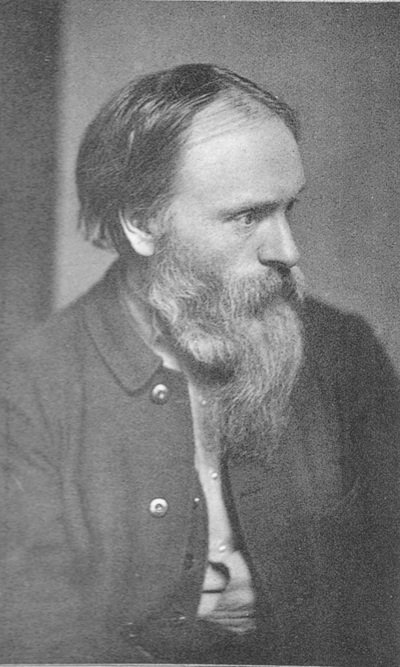

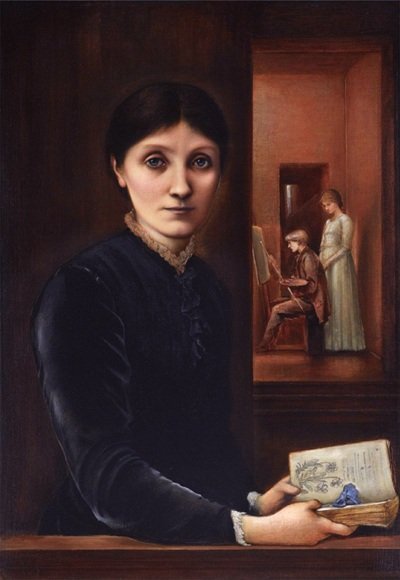

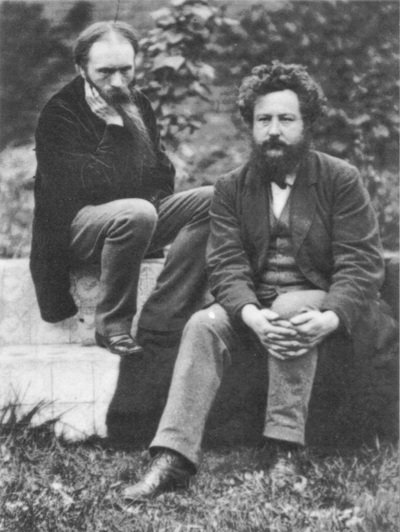

The beginning
Edward Burne-Jones (1833-1898) was born in Birminjngham, England to Edward Richard Jones, a welshman and Elizabeth Jones. His mother died soon after giving birth and he was raised by his father. He attended Birmingham King Edward’s school (1844) and Birmingham School of Art (1848 -1852). Then Exeter College which is Oxford’s fourth-oldest college in the present day. There he became lifelong friends wiith William Morris. They liked poetry and with a group of others they formed “The Brotherhood” which read the works of John Ruskin and Tennyson, visited churches, and idealised aspects of the aesthetics of the Middle Ages. They idolized Dante Gabriel Rossetti (1828 – 1882) and got him to contribute to their Oxford and Cambridge Magazine. Rossetti was one of the founders of the Pre-Raphaete society which rejected the academism of the Royal Academy and sought a return to the abundant detail, intense colors, and realism found in art before the Italian master Raphael. Their works drew themes from the Bible, Shakespeare, Keats, and Arthurian legends. Burne-Jones was strongly influenced. Although Rossetti was only a few years his senior, Burne-Jones received instructions and some call him a second generation Pre-Raphaelite. However Burne-Jones soon created his own style which leaned towards a more Aesthetic, Symbolistic style.
Marriage and a love affair
In 1856 Burne-Jones 23 years old became engaged to 15 years old . Georgiana “Georgie” MacDonald. Her brother Harry had attended King Edward’s School, the same school as Burne-Jones, and Georgie was introduced thru that connection. They married in 1860. Their first child Philip was born in 1861, their daughter Margaret in 1866. That same year, Burne-Jones met the beautiful Greek model Maria Zambaco. Her mother had commissioned him to paint a painting of her “Cupid finding Psyche”. This resulted in a pasionate love affair. In 1869. Burne-Jones even attempted to leave his wife for her but it fizzled out and the Burne-Joneses remained together. Maria Zambac appears in multiple Burne-Jones paintings such as “The Beguiling of Merlin” (1872–1877) and “Phyllis and Demophoön” (1870). It was a trying time for Georgia but she weathered it. After his death, in keeping with his wishes, she published his biography “The Memorials of Edward Burne-Jones” which became the definitive biography for Edward Burne-Jones.
His art
In 1856, Burne-Jones left Oxford University with no degree and found himself at a crossroads. He wanted to be an artist but had no regular training. He completed his set of skills by resolute labour. His idol Dante Gabriel Rossetti helped. Soon Rossetti himself admitted he had nothing more to teach him. In 1860 Burne-Jones completed two watercolors, Sidonia von Bork and Clara von Bork. In 1861 Burne-Jones’ friend William Morris founded the decorative arts firm of Morris, Marshall, Faulkner & Co. Burne-Jones became a partner, contributing designs for stained glass and tapestries until the end of his career. The company succeeded finacially. Meanwhile the love affair with Maria Zambac had resulted in “Phyllis and Demophoön” (1870), but it’s sexual assertiveness offended Victorian sensibilities and Burne-Jones withdrew from the Society. As a result only a few of Burne-Jones paintings were exhibited in the 1870-1877 period. However in 1877 Burne-Jones exhibited in the first exhibition of the Grosvenor Gallery. It was a big event attended by the Prince of Wales and was positioned to set new standards for art display and serve as an alternative to the conservative Royal Academy. Works of artists from outside the British mainstream were presented. Burne-Jones exhibited “the Beguiling of Merlin” and “the Mirror of Venus”. It served to catapulted careers of key figures in the Aesthetic Movement and Pre-Raphaelite Brotherhood. Edward Burne-Jones was a primary beneficiary. Burne-Jones followed this up with masterpieces such as “Pan and Psyche”. In 1879 he published the series “Pygmalion and the Image”. Next came the “Golden Stairs”. In 1883 the “Wheel of Fortune”, in 1884 “King Cophetua and the Beggar Maid”. He was elected an Associate of the Royal Academy in 1885 and became a baronet of Rottingdean in 1894.


The ending
In 1896, his lifelong friend William Morris died and Burne-Jones’ health deteriorated soon after. He died in 1898. His memorial service was held at Westminster Abbey. It was the first time an artist had been so honoured.
Pure Aestheticism: Venus’s Looking Glass
Click image. It will expand and scroll view. You can click control tabs on the upper left corner of the scroll view to skip (fast scroll), shift left or right, etc..
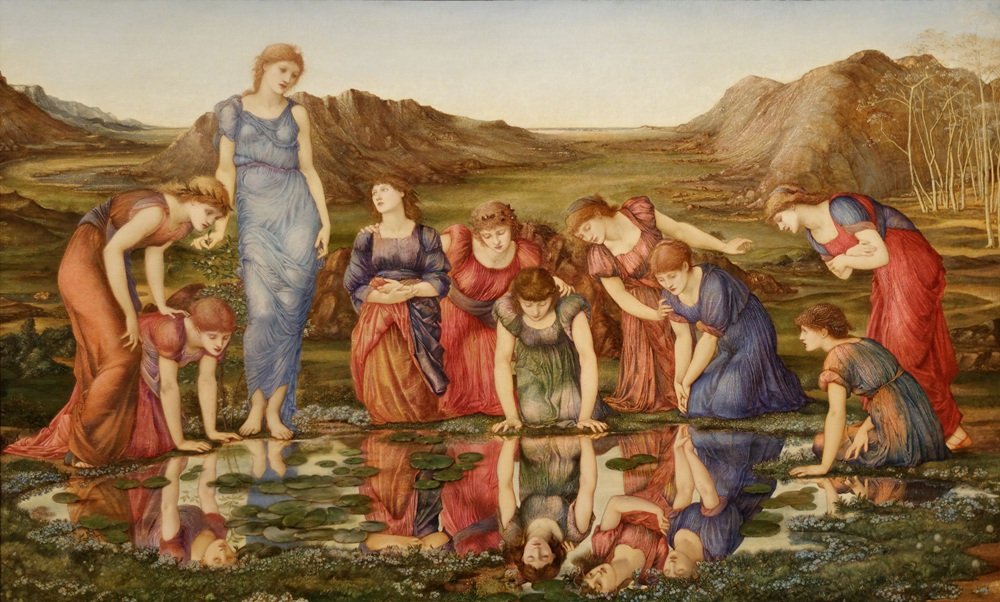
The Mirror of Venus (between 1866 and 1877)

This is an Aesthetic painting; “a beautiful romantic dream of something that never was, never will be”. Thus there is no storyline or reality, only a standing Venus, goddess of Love and Beauty and a group of beautiful women with their reflections in a pool of water. However the classical dress of the women hark back to the Pre-Raphaelite style. So Aestheticism with a little Pre-Raphaelite art in the mix. Burne-Jones exhibited this in 1877 at the first Grosvenor Gallery Exhibition, This lead to the recognition of Burne-Jones as an leading artist.
One Aesthetic and three allegoral Paintings
In the following there are three allegoral paintings. Visual renderings of something that has great moral or spiritual significance.
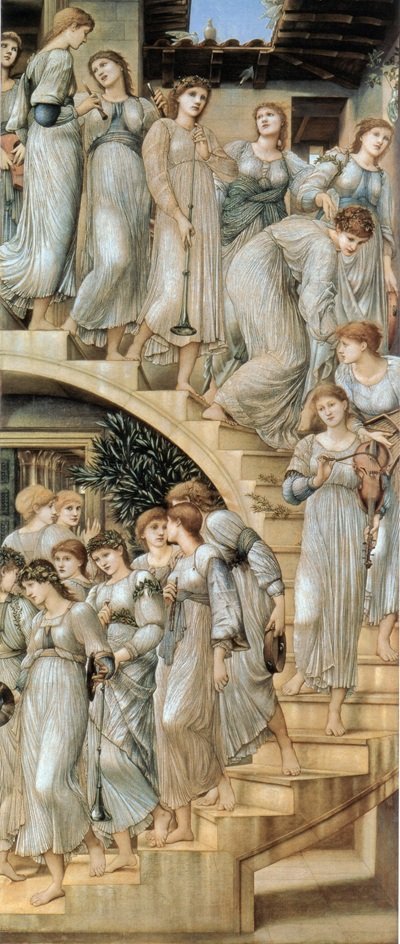
- The Golden Stairs (1880): : An Aesthetic painting and one of the best-known by Burne-Jones. There is no narrative. It just sets the mood. A harmony of colors that catches the eye. Just some women decending the stairs. Where are they going? No one can tell. In the group of women. his daughter Margeret holding a trumpet is 4th from top, May Morris, daughter of William Morris holding a violin is 9th, There are also Lady Horner, daughter of William Graham and Mary Gladstone, daughter of William Gladstone.
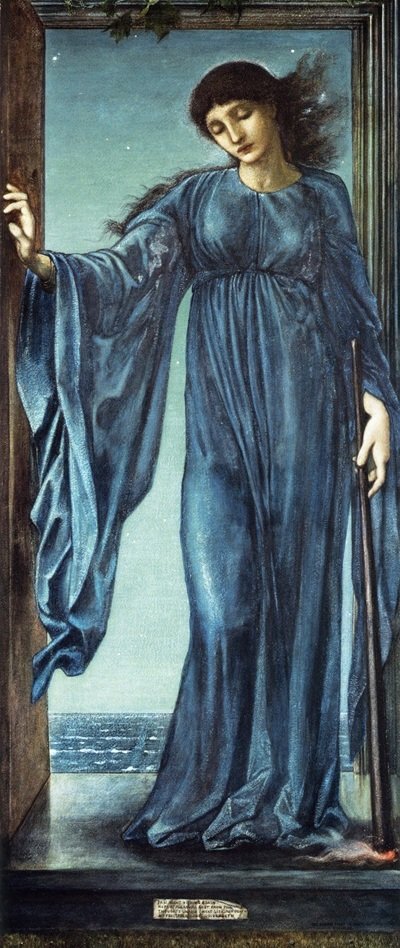
- Night (1870) : An allegoral painting with some lines at the bottom by friend William Morris. I AM NIGHT & BRING AGAIN; HOPE OF PLEASURE REST FROM PAIN; THOUGHTS UNSAID TWIXT LIFE AND DEATH; MY FRUITFUL SILENCE QUICKENETH. Night is a female figure. She is not a frightning presense. She provides “rest from pain” and allows “thoughts unsaid” to find meaning. The “fruitful silence” is a fertile space for creativity and meditation contrasting with the busy, industrialized reality of Victorian England.
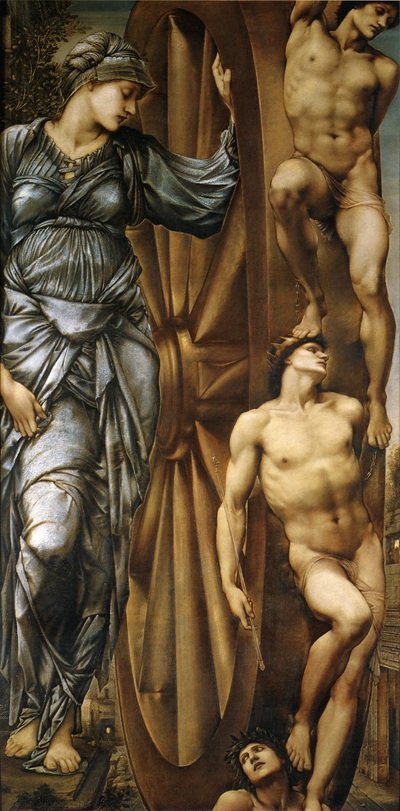
- La ruota della fortuna-The wheel of Fortune (1875-1883) : This represents an allegory of the vagaries of life. Some are elavated and some are crushed. In the center is a wooden wheel. To the left is the goddess Fortune. On the right are three nude males. At the top, a slave standing on top of a king with crown and sceptre and at the bottom a poet with laurel wreath staring at the goddess.
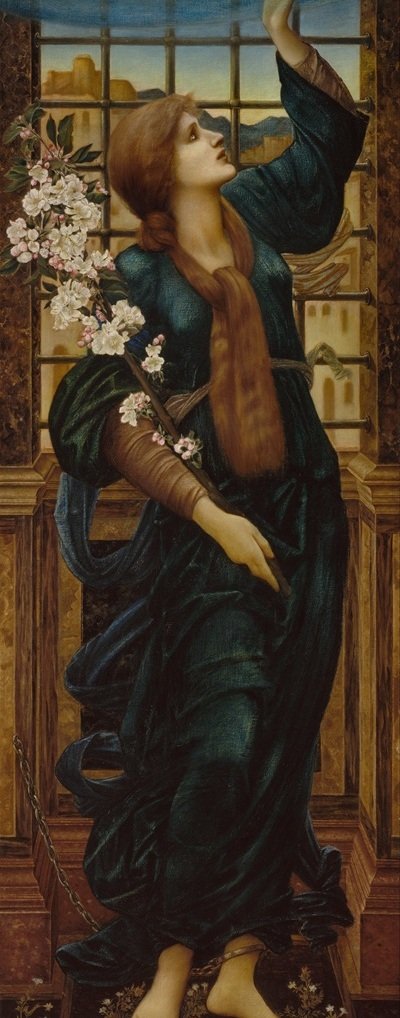
- Hope (1896) : 1896 was the year lifelong friend William Morriis died. Burne-Jones was devastated. He created this allegoral painting “Hope”. A bound woman with chains on her feet reaches skyward in spite of the bars on her window. She has a sprig of apple blossom in her hand that represents “hope”.

.jpg)


The “Pygmalion and the image ” series
The story of “Pygmalion”
The following images derive from and are renditions of the story of Pygmalion. Many variations exist but it was part of Ovid’s Metamorphoses. Ovid was a Roman poet from 8 CE and Metamorphoses was his magnum opus. It chronicled the history of the world from creation to Julius Caesar and consisted of 250 myths and 15 books. It is one of the most influential works in Western culture and inspired authors such as Dante Alighieri, Geoffrey Chaucer, and William Shakespeare. The tale of Pygmalion is a portion where numerous episodes have been depicted in works of sculpture and painting.
The story goes like this: (1) Pygmalion was a talented sculptor but was disillusioned by the immoral behavior of living women. So he swore off romance and dedicated his life to art. (2) One day he sculpts the perfect woman. It was a statue of such unparalleled beauty that he named it Galatea and fell in love. So Pygmalion prayed to Aphrodite the goddess of love for a wife just like her. (3) Aphrodite responded and brought Galatea to life. (4) Pigmalion kissed Galatea and they lived happily ever after.
The story of an artist falling in love with his own creation appealed and variations were created even in modern times. For example, George Bernard Shaw’s Pygmalion is a 1912 play about a pompous phonetic professor, Henry Higgins, who bets he can turn a rough-spoken Cockney flower girl, Eliza Doolittle, into a society lady is a variation. The famous 1964 Hollywood film “My Fair Lady” staring Audrey Hepburn is in the same vein.
Burne-Jones’ rendition : “Pygmalion and the Image”
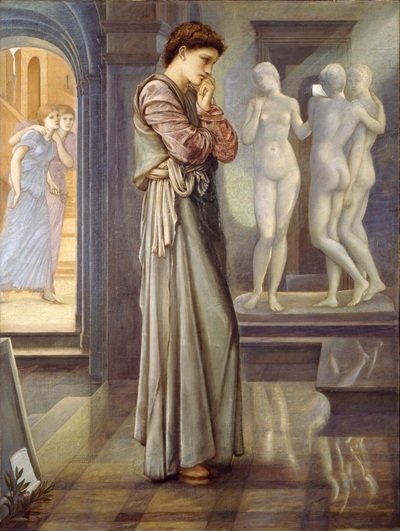
- Pygmalion and the Image – The Heart Desires (1878) : Pygmalion is in his studio, living a lonely life, chosing to remain celibate and disgusted at the debauched lives of the local women.
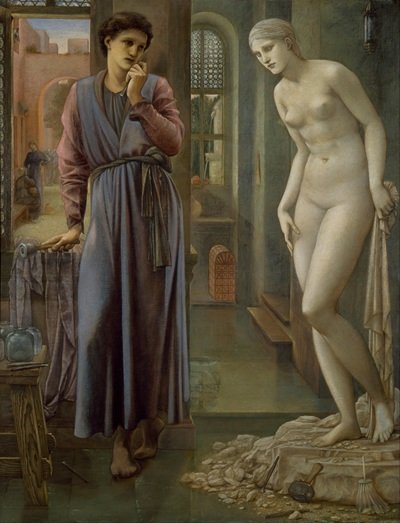
- Pygmalion and the Image – The Hand Refrains (1878) : Pygmalion has created his perfect woman. He looks at her with longing.
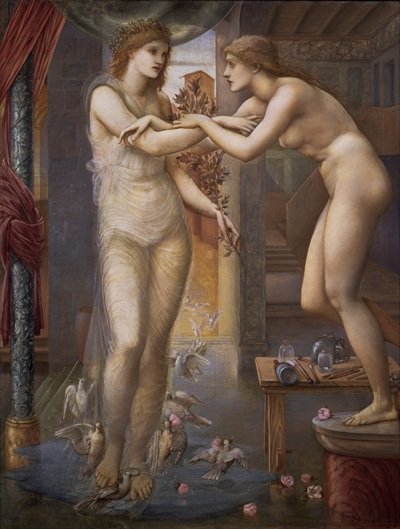
- Pygmalion and the Image – The Godhead Fires (1878) : Aphrodite on the left appears in the studio and imparts life to Galatea.
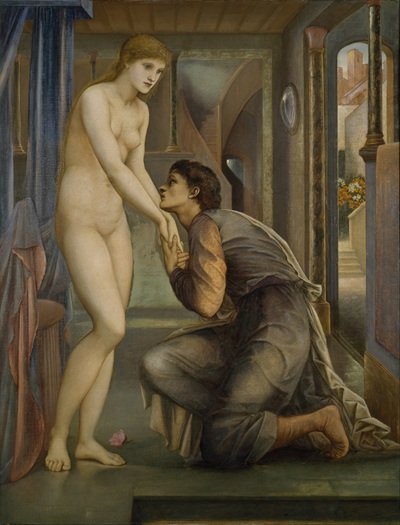
- Pygmalion and the Image – The Soul Attains (1878) : Pigmalion begs Galatea to marry him. They live happilly ever after.
.jpg)


Other renditions of “Pygmalion” in the 18-19th century
The tale of Pygmalion was a favourite theme for top ranking artists in the 18-19th century. Here are some masterpieces in chronological order.
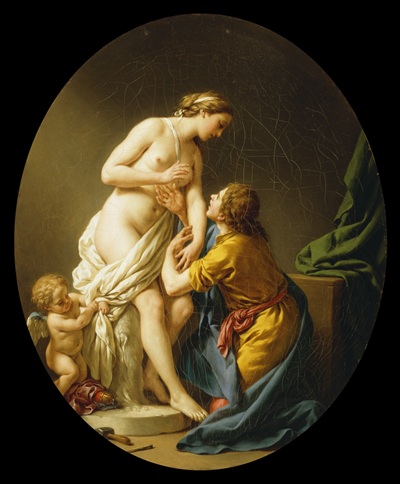
- Pygmalion and Galatea (1781) by Louis-Jean-François Lagrenée (1725–1805) : This is a French painting Rococo style, lighthearted and ornamental. It depicts the exact moment Pygmalion’s marble statue of the perfect woman came to life, turning from stone to flesh.
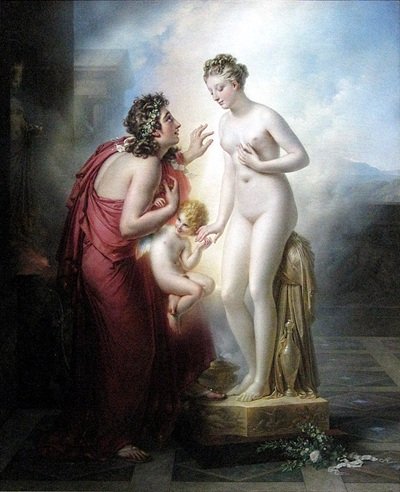
- Pygmalion et Galatée (1819) by Anne-Louis Girodet (1767–1824) : This is a French painting in Neoclassical style, strict and realistic. It depicts the exact moment Pygmalion’s statue came to life. However it departs from true Neoclassisism in the use of vaporous, theatrical light. This departure was Girodet’s hallmark.
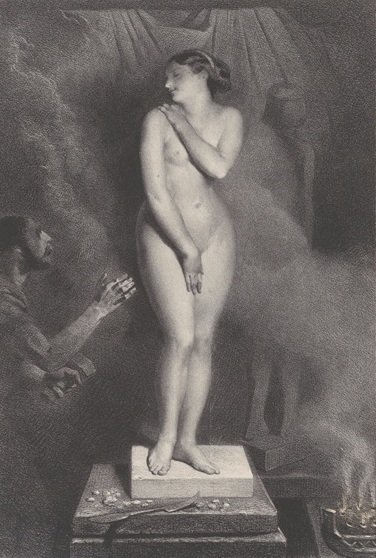
- Pygmalion and Galatea (1852-62) by Jean Gigoux (1806–1894) : A classical lithograph by French artist Jean-François Gigoux.It is noted for capturing the transformative magic of the myth in a dramatic way and also showing the artistic tension between creator and creation. The dramatic flair is a characteristic of the French Romantic movement which was a cultural rebellion that rejecterd Enlightment and Neoclassical strictness.
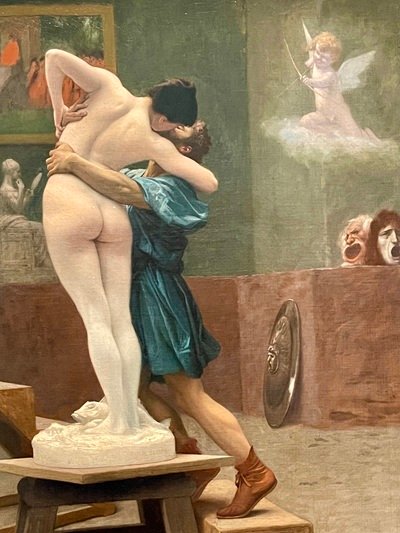
- Pygmalion and Galatea (1890) by Jean-Léon Gérôme (1824–1904) : This depicts the exact moment inanimate ivory turns into a living human. Gérôme departs from previous work in that the lower legs are still cold white marble, while the upper portions of the body have the warm, pinkish hue of flesh. Also Gérôme frames the scene from behind, showcasing the arch and beautiful curve of her newly flexible body.


,_detail.jpg)
The Mythological Paintings
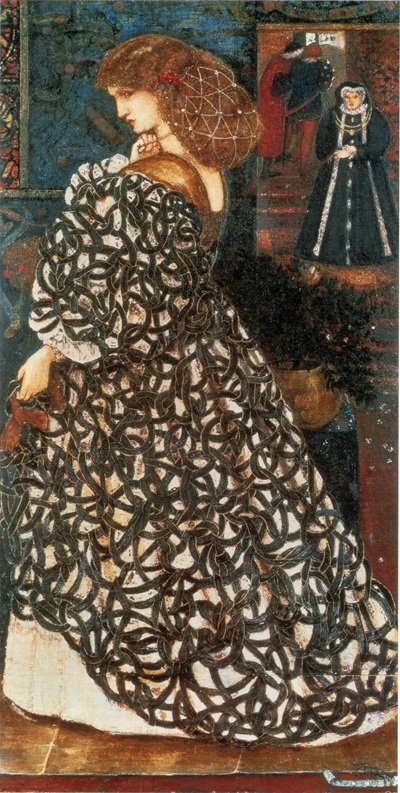
- Sidonia von Bork (1860): This is one of three figure studies, among the earliest watercolours Burne-Jones completed. The subject is from Wilhelm Meinhold’s romance ‘Sidonia the Sorceress’. The novel is set in 16th century Pomerania and tells the tale of evil noblewoman Sidonia, whose beauty captivates all. She was executed as a witch in Stettin (modern day Szczecin, Poland). The 19th century was fascinated by the concept of the femme fatale and she was a femme fatale, like the sirens, Circe, or the biblical Eve in myths. This was a fascinating painting of an alluring, seductress bringing disaster or ruin to any man who becomes romantically involved.
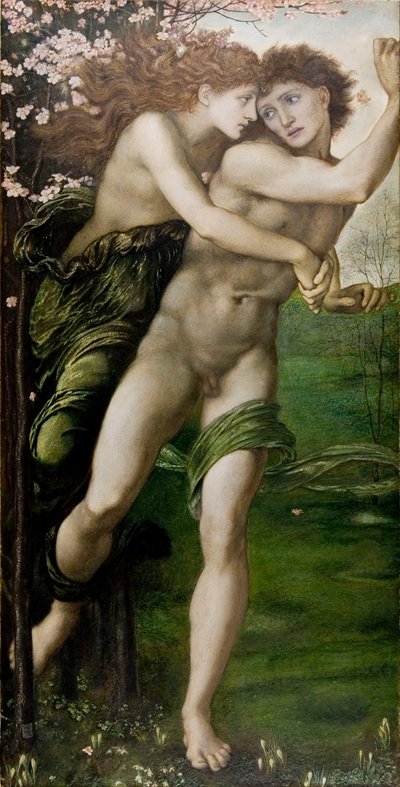
- Phyllis and Demophoon (1870): The narrative is from Geoffrey Chaucer’s “The Legend of Good Women”. Phyllis, queen of Thrace, falls in love with Demophoön, son of Theseus. Demophoön leaves her, but promises to return. However he breaks his vow and Phyllis thinking herself abandoned commits suicide. The gods of Greece takes pity and transform her into an almond tree. Demophoön returns and embraces the tree which turns back into Phyllis. Burne-Jones exhibited this in 1870 but there was a scandal because of the full-frontal male nudity of Demophoön. Also Phyllis presses against Demophoön possessively. This went against the mores of Victorian England. In Victorian England it is the male who is the aggressor not the female. The Society requested that Burne-Jones cover up the offending part in the nude male but Burne-Jones offended by this slur on his art, withdrew the painting and also resigned from the Society. He did not exhibit again for 7 years. There was also a personal dimension. Burne-Jones at that time was having a passionate extramarital love affair with Greek model Maria Zambaco. Phyllis could easily be recognized as Zambaco and Burne-jones had portrayed Zambaco as the aggressor which went against Victorian England mores.
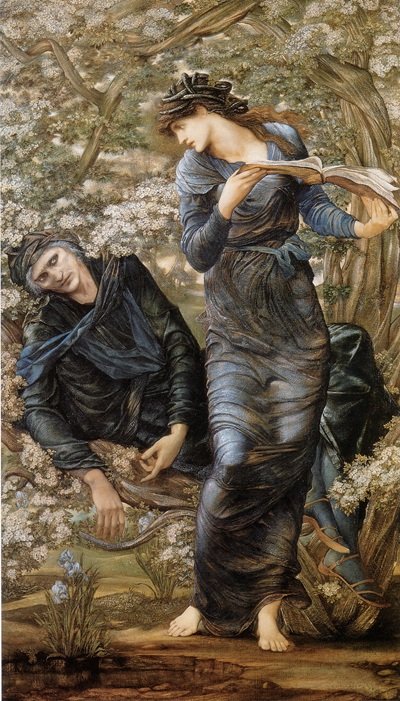
- The Beguiling of Merlin (1874) ; This depicts a moment in the legend of Arthur where the sorcerer Merlin is tricked and trapped by Nimue, the Lady of the Lake. Nimue uses Merlin’s own magic against him. She learned his enchantments by exploiting his infatuation with her to seal him inside a hawthorn bush forever. The scene is intense because it had roots in Burne-Jones own life. Burne-Jones was infatuated with his model for Nimue, Maria Zambaco, a Greek-British artist, model and heiress. They had a very public love affair (1866 – 1872) that culminated in a suicide attempt. Burne-Jones later admitted his helpless infatuation with Zambaco mirrored Merlin’s tragic undoing by Nimue.
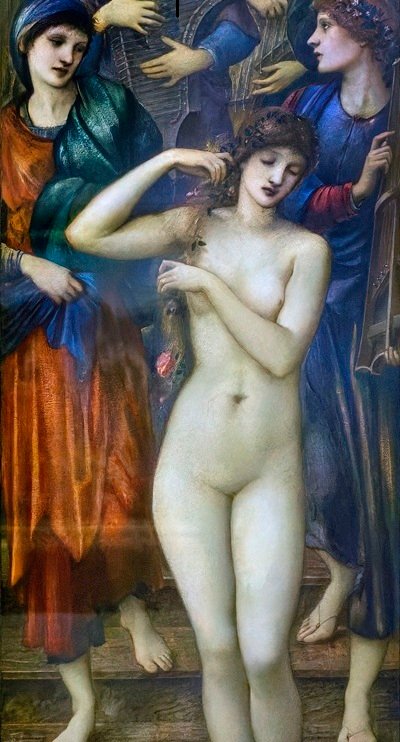
- El baño de Venus; acuarela (1888) : The Bath of Venus in watercolor. This is a Aesthetic painting emphasizing harmony and poetic atmosphere over narrative. Venus is nude amid fully clothed female attendants. She avoids looking directly at the viewer and radiates a sense of vulnerability, isolation, and unhappy love.


.jpg)
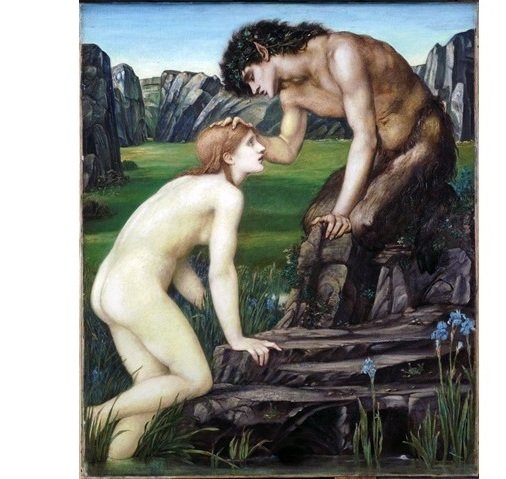
- Pan and Psyche (between 1872 and 1874) : This depicts the god Greek Pan comforting Psyche. Psyche and the god of Love, Cupid were having an affair. But Psyche breaks trust and is abandonned. Psyche in distress tries to drown herself in a river. However the river carries her to a meadow and she meets the god Pan. The painting captures the moment Pan comforts the maiden, assuring her that her pain will ease and she will find happiness again.
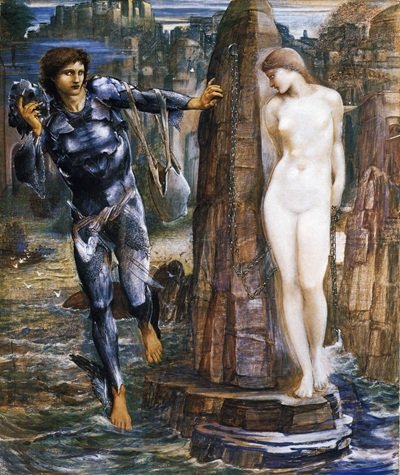
- The Perseus Series: The Rock of Doom (1884-1885) : This is part of Burne-Jones Perseus Series. In the painting Perseus discovers princess Andromeda chained to a sea-worn rock, She has been offered as a human sacrifice to the angry sea god and Perseus has arrived to save her from a sea serpent. The composition emphasizes stark, dramatic contrast. Perseus is standing in a heroic pose, clad in shiny, metallic armor. In contrast, Andromeda is depicted nude. Her lovely body shines white. Their eyes lock in a highly emotionally charged moment.
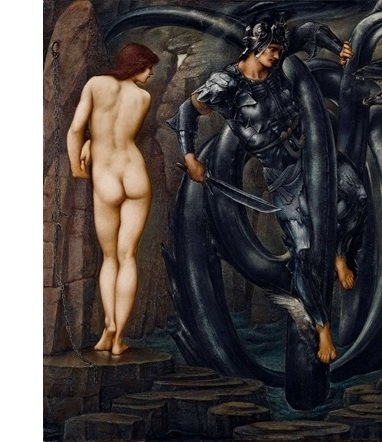
- Perseus Cycle 7: The Doom Fulfilled (1888) : This depicts the climax of the rescue of Andromeda. The previous painting in the cycle (The Rock of Doom) showed Perseus discovering Andromeda chained naked to a rock, The Doom Fulfilled captures the intense battle immediately following her release. Perseus stands inside the serpent’s coils and raises his sword to deliver the final blow. Andromeda stands to the side on a stone ledge. She has her back to the monster and demurely turns her gaze away.
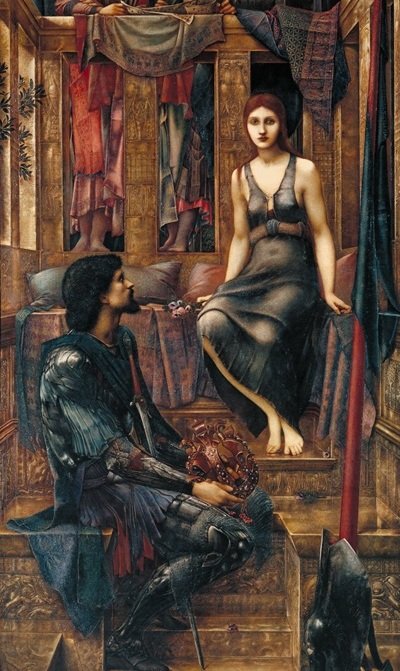
- King Cophetua and the Beggar Maid (1884) : Do you know this storyline? Rich man meets beggar girl, loves at first sight, marries her and lives happyily ever after. The founding story comes from the a 16th century ballad. Cophetua, African king is known for his lack of interest in women. However while looking out of his palace, he sees a young beggar girl, Penelophon, dressed in raggs. It is love at first sight. Tthe king declares he will marry her. Penelophon agrees and they live a life of bliss. This painting by Burne-Jones is the most famous adaptation of the story. It captures a moment where King Cophetua, sets aside his crown and shield, sits at the feet of the beggar maid with devotion in his gaze. The beggar maid him sits on a raised throne and looks at the viewer.


Burne-Jones’ Foray into Stained Glass Art
Burne-Jones had a lifelong friend called William Morris (1834–1896). They met at Oxford University in 1853. They would devoted their lives to social change through art. In 1861 William set up a decorative art company (Morris, Marshall, Faulkner & Co) and Burne-Jones became a partner and designer of stained glass windows. They aimed to counter the effects of the mass produced, low quality goods of the industrial revolution and revive medieval crafts and beautify objects in everyday life. At that time, there was a surge in the Neo-Gothic construction and refurbishment of churches and the company became famous for it’s stained glass windows. The company closed in 1940 but left an indelible mark on the British Arts and Crafts movement. The following are examples of their work.
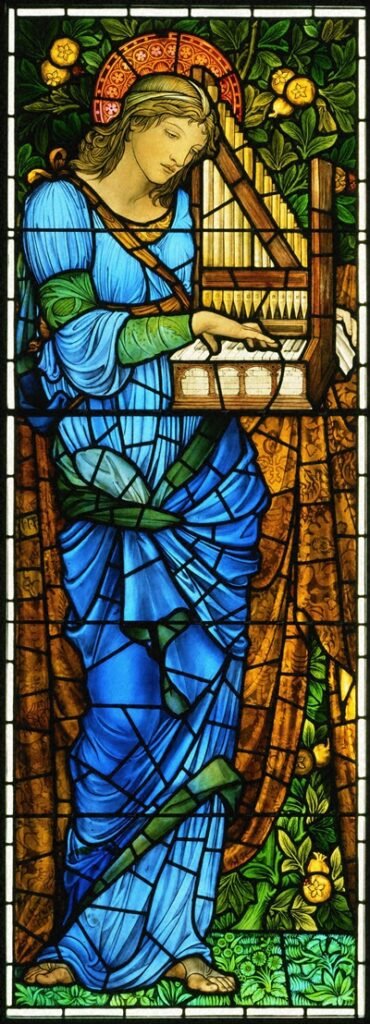
- Saint Cecilia (1900) : Saint Cecilia was an early Christian Roman virgin martyr. She was the patron saint of music and is portrayed here with a portable organ. The stained glass is at the Chist Church Cathedral, Oxford, a church famed for it’s choir. So the Saint Cecilia image is a perfect fit.
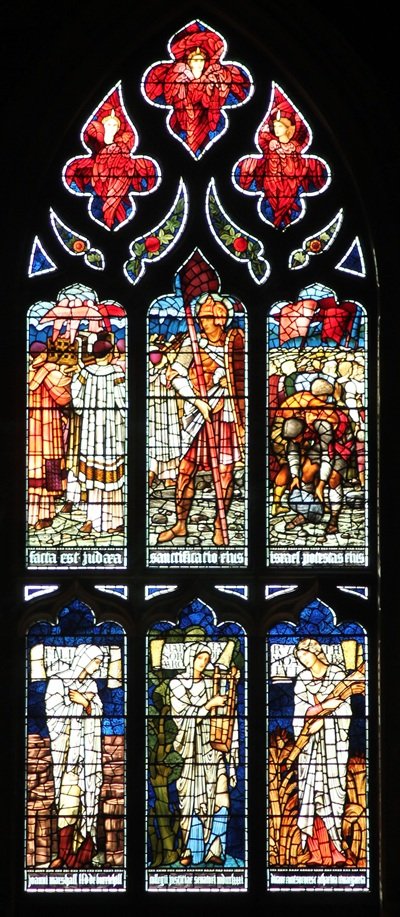
- Israelites crossing the Jordan (1886): This stained glass was designed for St Giles’ Cathedral, Edinburgh. The story is from the Hebrew Bible. It shows Israel crossing the Jordan in the in the upper section. Ruth, Miriam, and Jephthath’s daughter in the lower section.


Notes
The comments above reflect only the thoughts the administrator had while viewing the images. They might or might not be comments by the artist, subjects or the photographers etc.. Please excuse any inaccuracies. You are welcome to leave comments in the comment space. Otherwise send messages to “kohi@scroll.kohibiz.com”.
Click the underlined titles. This will link you to the original site from which the images were taken including license information. We believe there is no problem with the image license. Most are in the public domain.
Most images are from Wikimedia Commons. If there are any problems please leave a message. Images will be taken down if necessary. Some images have been cropped from the original using the Vertical Scroller application program. This is to ensure the best viewing experience.