This post is a collection of images by the English Victorian Neo-Classicist painter John William Godward (1861-1922). He was famous for his incredibly realistic paintings of beautiful young women. The women he painted were in a classical settings amid marble stones, wearing Roman style togas etc. This served to glorify the culture of for example ancient Greece and Rome. The paintings also exudes an air of tranquility which is typically Godward. Enjoy !
This site attempts to make apparent the beauty hidden in images thru the site’s image scrolling function.
Choose an image, It will expand and scroll view. You can click control tabs on the upper left corner of the screen. Depending on the tab, you can (1)fast scroll (skip button), (2)expand, (3)minimize, (4)shift right or left, (5)pause or (6)scroll up or down. You will see details not noticed in normal viewing. This will reveal beauty hidden from you before.
Some comments by the administrator of this site have been added. I believe a painting is more enjoyable when a person understands some of the history and circumstances behind each painting. Enjoy !
Godward’s Biography
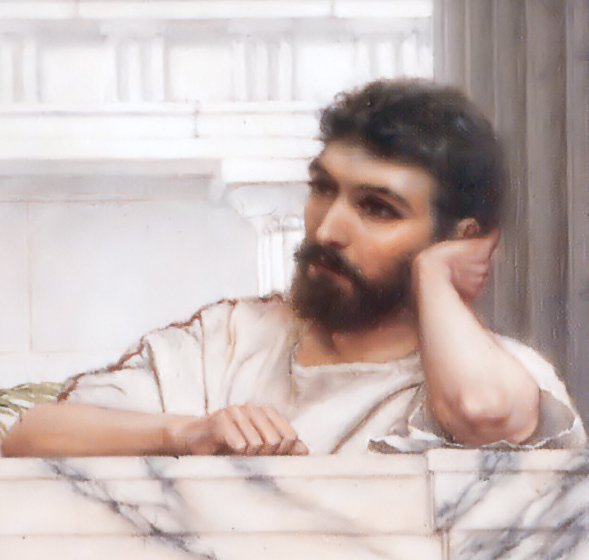
Some say this is Godward himself
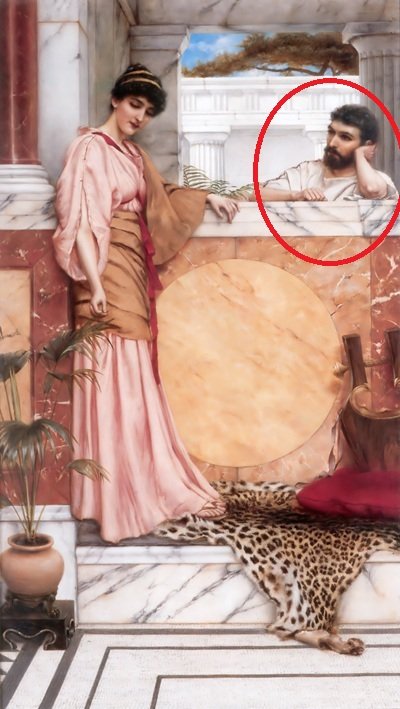

The total image
John William Godward was born in 1861 to Sarah Eboral and John Godward who was an investment clerk at the Law Life Assurance Society in London. He lived in Wilton Grove, Wimbledon and was the eldest of 5. His grandfather William Godward had worked in the life investment business and made some investments in the Great Northern Railways which had been formed in 1846. This had succeeded. His father John Godward had followed in his father’s footsteps and worked as an investment clerk. When William died John inherited a lot of money. So the Godwards were a well to do middle class family. His parents were very strict and expected the children to follow their father. Three younger brothers Alfred, Edmund, and Charles enthusiastically entered the world of insurance. As the eldest, John William was forced to work as an insurance clerk but hated it.
It is not known how John William developed a taste for art, but his family despised it. They regarded the path of a professional artist as a path of lowly status, a slight on family values. In 1887 at the age of 26, John William decided to move away from his family. He rented a small atelier in the Bolton Studios in Gilston Road, Kensington. There were many such ateliers and artist such as Théodore Roussel, George Morton, St. George Hare, George Lawrence Bulleid and William Reynolds-Stephens were nearby. This was a good place to exchange ideas and meet. The push for the move also came from the acceptance by the Royal Academy of John William’s painting for that year’s Summer Exhibition. For young artists, the opportunity to exhibit was a big deal, often leading to fame and sales. Godward was firmly on the path to becoming a professional artist. In 1889, Godward created some 20 plus paintings which went to his favored art dealer Thomas Miller McLean who sold many of his works. One of the paintings was “Waiting for an answer” shown on the left. It is typical Godward art with a beautiful slim woman in classical dress, languid pose, amide animal skins and huge marble structures. All typical of Godward. The man on the right is said to be Godward himself. Because of Godward’s estranglement, his family destroyed all images of the artist so this might be the only image existing.
In 1904 his father died. Next year Godward went to Italy for the first time. He journeyed around the Gulf of Naples, visited Sorrento and the historical site of Pompeii which became one of his favorite places. After this, in 1912, Godward moved to Italy and stayed there for about 10 years. The reason is unclear but it is said that he moved with one of his models. This could be construed as a liaison between a woman of low repute and a Godward. The Godward family was vehemently oposed. They cut off Godward compleletely. In 1921 Godward returned to England because of ill health and committed suicided in 1922. He was only 61. When his family heard they were ashamed of him and burned his papers. That is why there are no images of him left.
When Godward suicided, he left a note “The world is not big enough for both myself and a Picasso”. Godward had come far in the classical style, exhibiting numerous paintings at the pretigeous Royal Academy, but his style had gone out of favor. Godward was probably one of the most talented artists in the classical style but artists were pioneering new fields of art. Impressionism, Cubism, Surrealism etc.. Godward had gone far but not far enough.
In short Godward was a Victorian Neo-classicist. A follower of Frederic Leighton president of the Royal Academy. It is also said he was the protégée of Sir Lawrence Alma-Tadema and shared a tendency to paint classical architecture constructed with marble. His main subjects were beautiful women in classical dress, maybe Roman style togas posing against the marble. His oeuvre included semi nude or nude women.
The Languid Classical Life
The following are examples of beautiful young women in classical dress lounging in the sun. Godward found inspiration in the classical ideals of ancient Greece and Rome. There is a deep sense of tranquil, static beauty in his paintings.
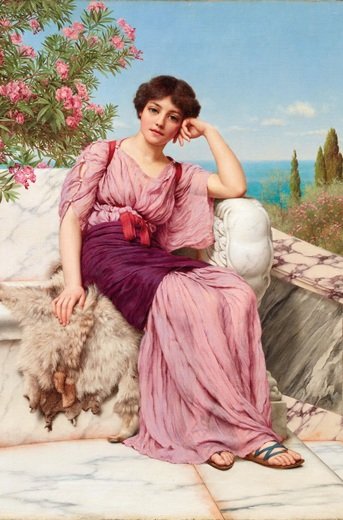
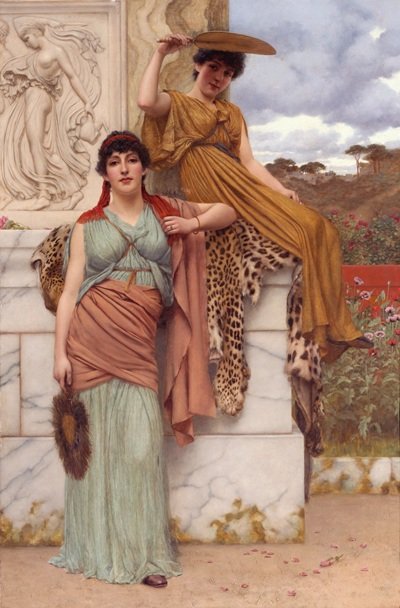
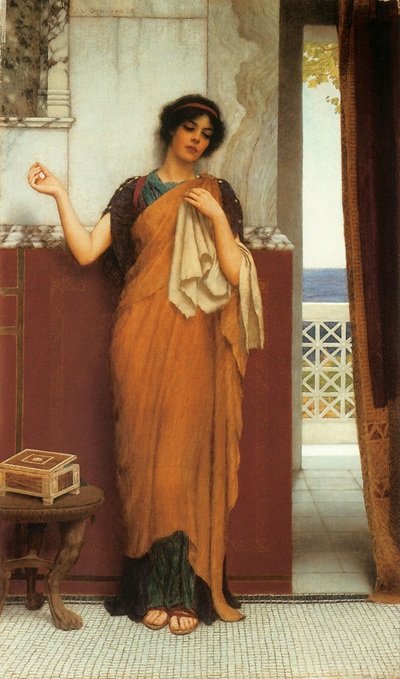
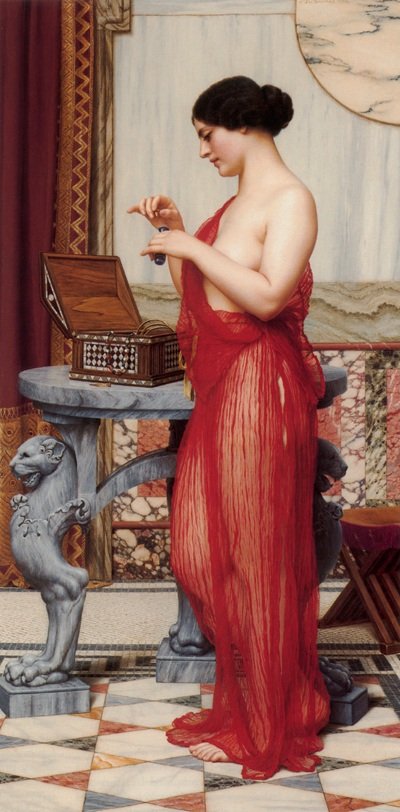
- Sweet Dreams (1904):
- Waiting for the procession (1890:
- Idle Thoughts (1898):
- The New Perfume (1914):


The Stages of lOVE
Examples of Roman or Greek beauties in various stages of love rendered in Godward’s typical neo-classical style. There is sense of deep quietness in his paintings.
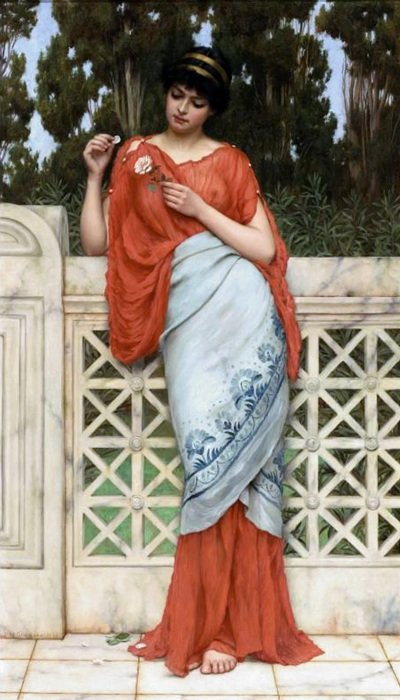
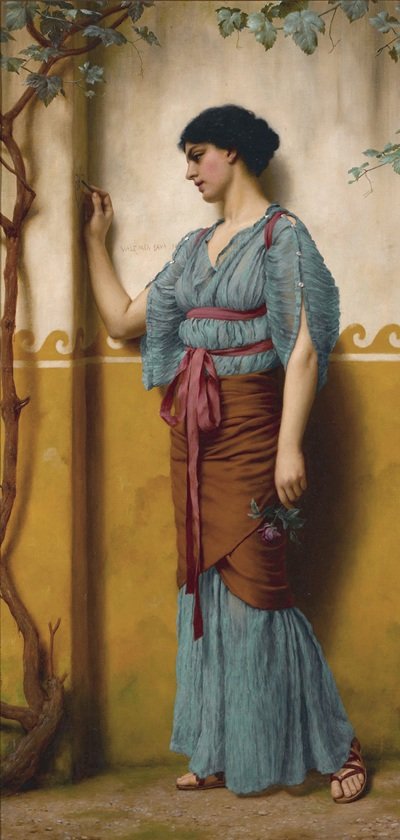
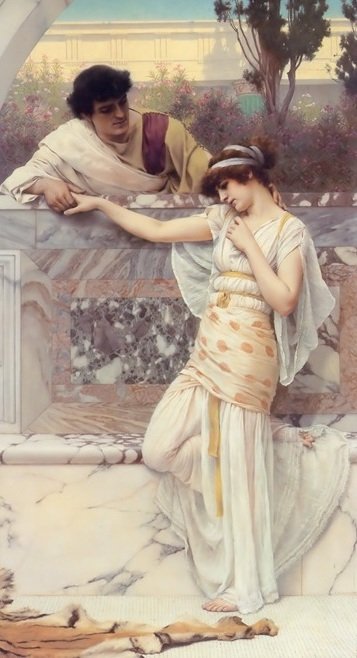
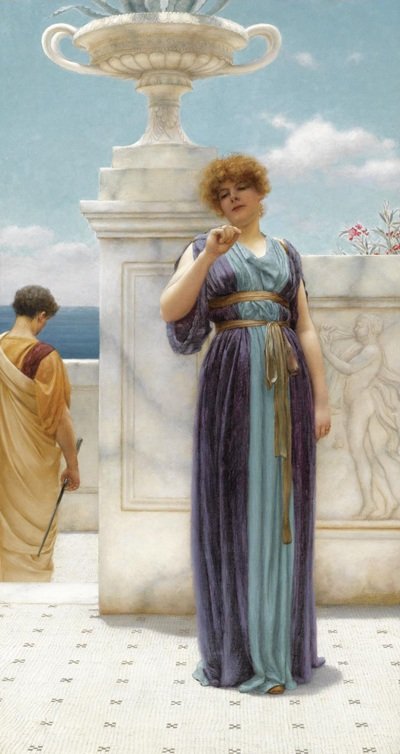
- He Loves Me, He Loves Me Not (1896)
- The Trysting Place (1907)
- Yes or No (1893)
- The Engagement Ring (1891)


The Women of Pompeii
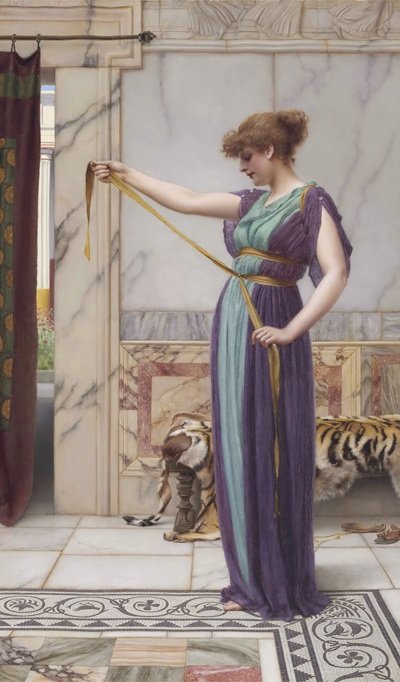
Pompeii, a Roman city of 10,000 to 20,00 people was buried under 4 to 6 m volcanic ash in the eruption of Mount Vesuvius in 79AD. It was rediscovered in the 16th century. Major excavations begun in mid-18th century. At the time of Godward it was a tourist spot. Godward used the ancient Roman city of Pompeii as a backdrop for his highly detailed, idealized portraits of classical beauty. His paintings ignore the tragic volcanic destruction of Pompeii, and instead captures quiet, timeless moments of leisure and domesticity.
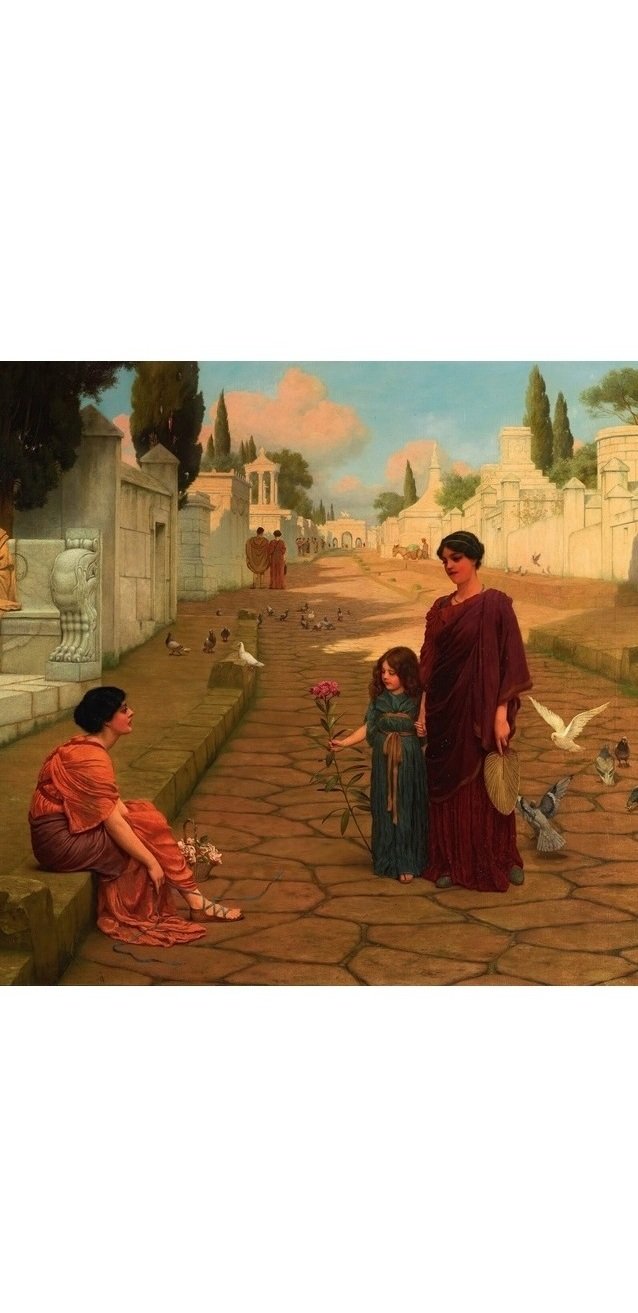
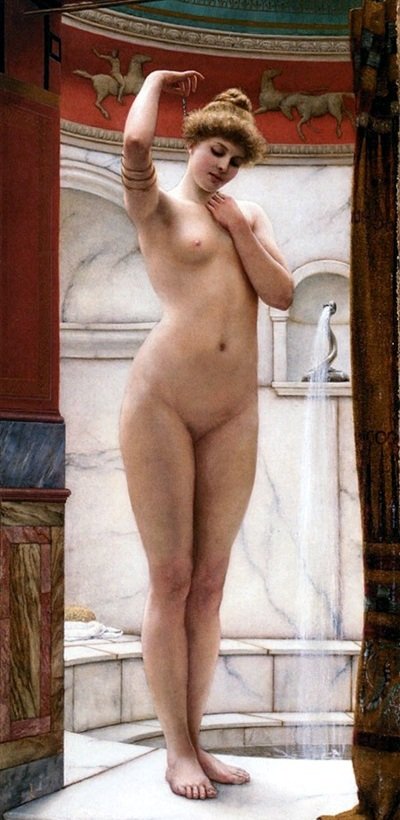
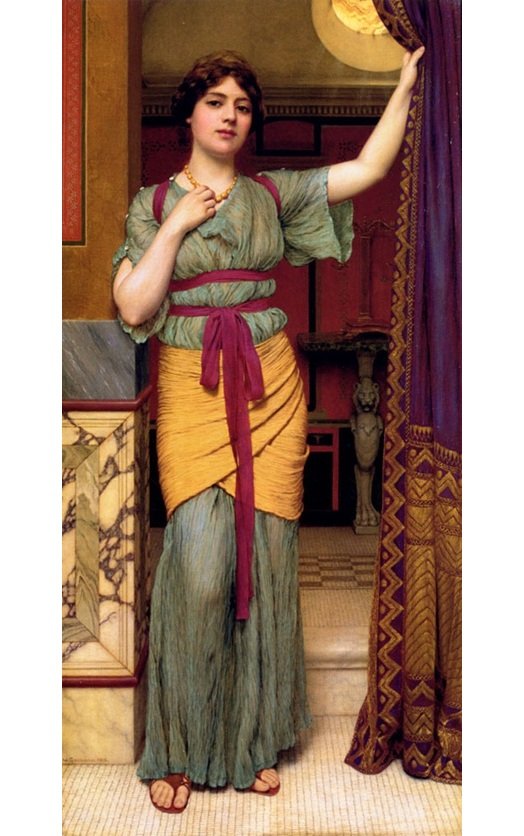
- Outside The Gate Of Pompeii (1905)
- A Pompeian Lady (1891)
- A Pompeian Bath (1890)
- A Pompeian Lady (1916)


The Baths
Baths in ancient Rome were centers not only for bathing, but socializing, reading and exercise. A public bath was built around three main rooms: the tepidarium (warm room), the caldarium (hot room), and the frigidarium (cold room). Godward revisited the theme of ancient baths multiple times, using it to show off his mastery in rendering the figures of his beautiful female models in various stages of undress as well as his mastery rendering the textures of cool, polished marble, diaphanous fabrics, and reflective water.
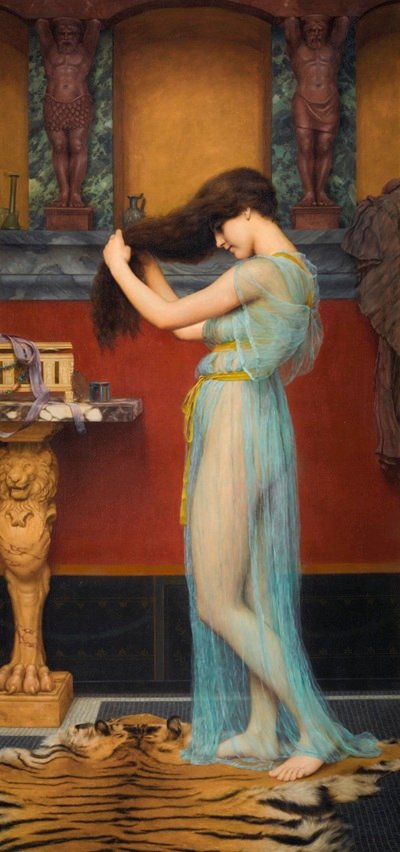
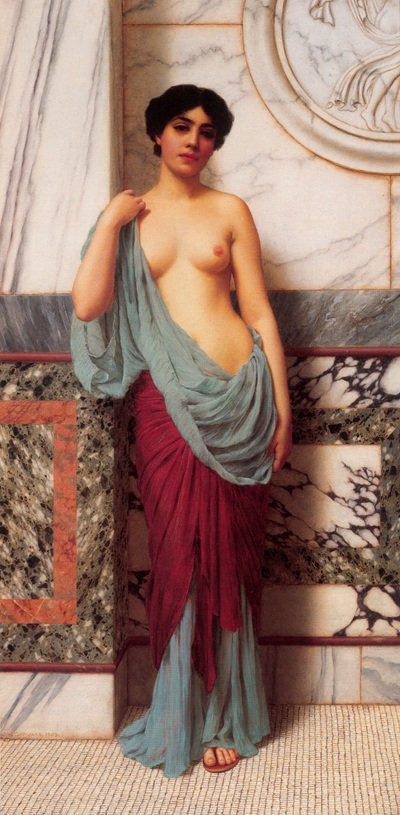
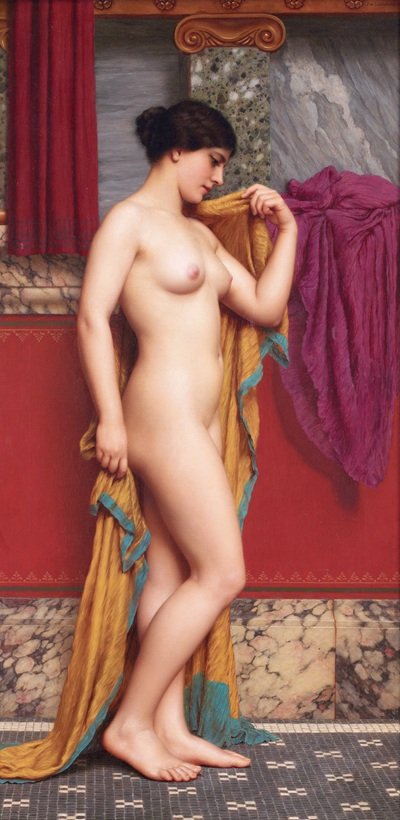
- Preparing for the Bath (1900)
- At the Thermae (1909)
- In the Tepidarium (1913)
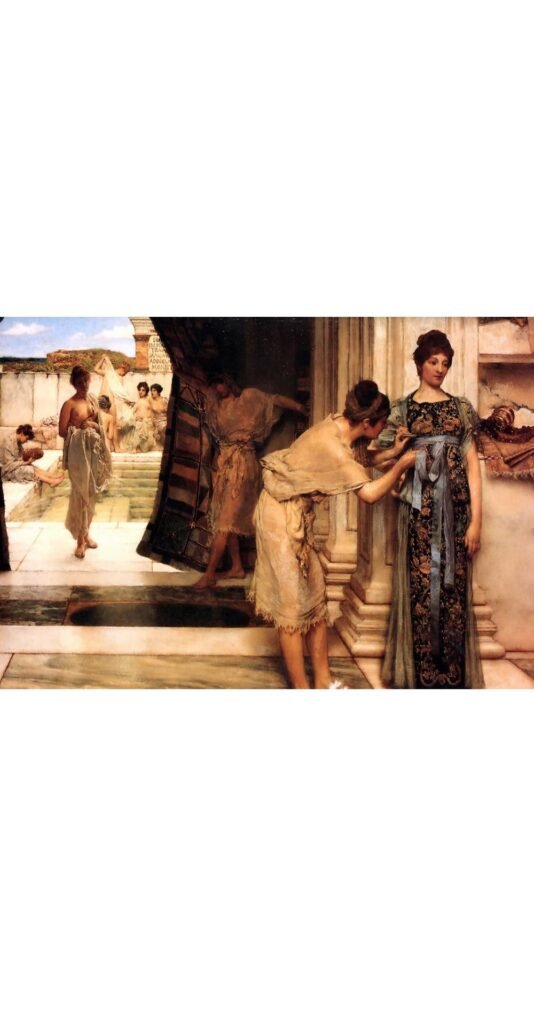
- The Frigidarium (1890) by Lawrence Alma-Tadema (1836–1912): This is not a Godward painting. It is shown here because it captures the atmosphere of the bath complex of ancient Rome well. The woman in the front is probably a matron and a slave is attending to her dress. On the left women are bathing and socializing.


The Mythological Godward
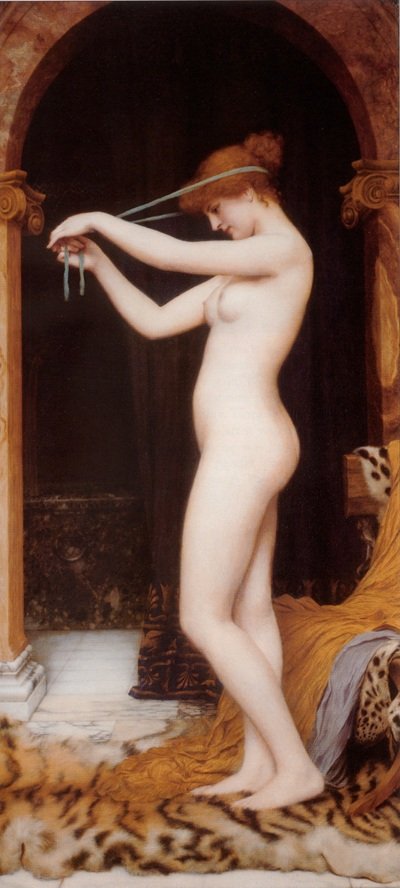
- Venus Binding her Hair (1897): The goddess of love and beauty is presented nude. She has a delicate form and soft light seem to radiate from her white body. The goddess is aranging her hair. This is an intimate moment. The rich drapery, the costly animal pelt carpet emphasizes the opulence of the scene.
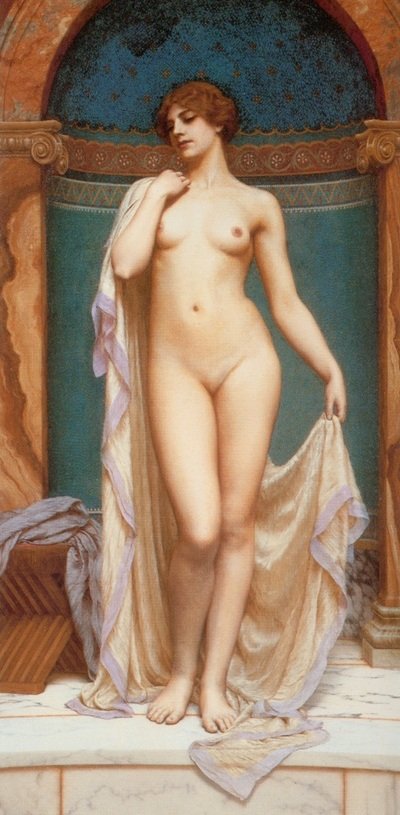
- Venus at the Bath (1901); The goddess Venus stands regal, gracefull in the center. She is clothed in a flowing, delicate cloth that does not conceal her soft and elegant form. Her gaze is gentle but regal. evoking a sense of tranquility.
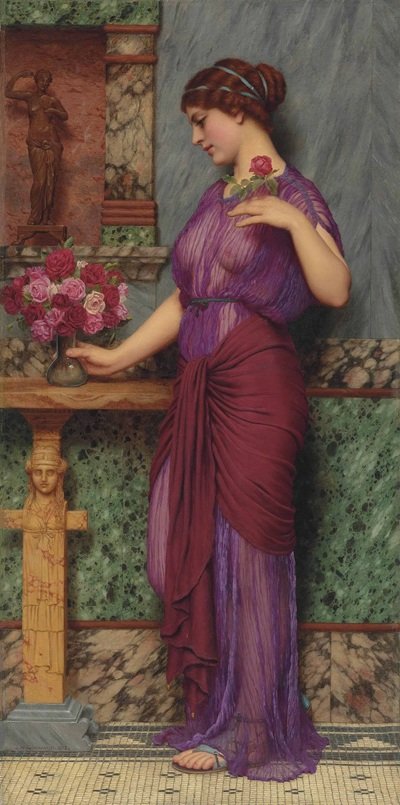
- An Offering to Venus (1912): This represents a young woman in a vibrant red dress. She wears diaphanous cloth that emphasizes her lovely figure. She holds a red rose close to her chest and arranges a vase of roses. This symbolizes devotion to Venus, the Roman goddess of love.
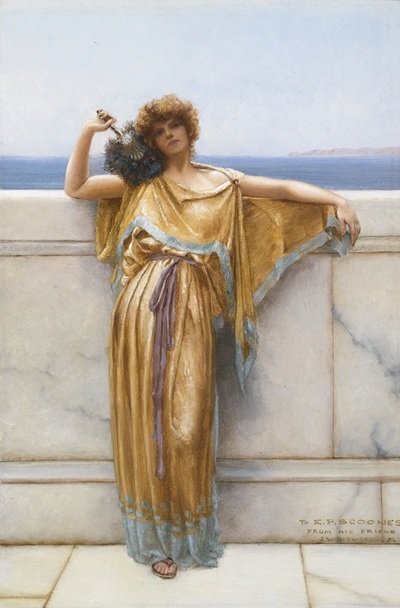
- Clymene (1892) : This depicts a beautiful woman in a flowing golden classical gown leaning against cool marble stone. It captures the romanticized leisure of antiquity. The subject is Clymene, a Titan goddess in Greek mythology, daughter of the Titans Oceanus and Tethys, She was the goddess of renown, fame, and infamy. She had four sons, Atlas, Epimetheus, Prometheus and Menoetius.


The Priestesses
Here are some of Godward’s depictions of mythological figures from antiquity.
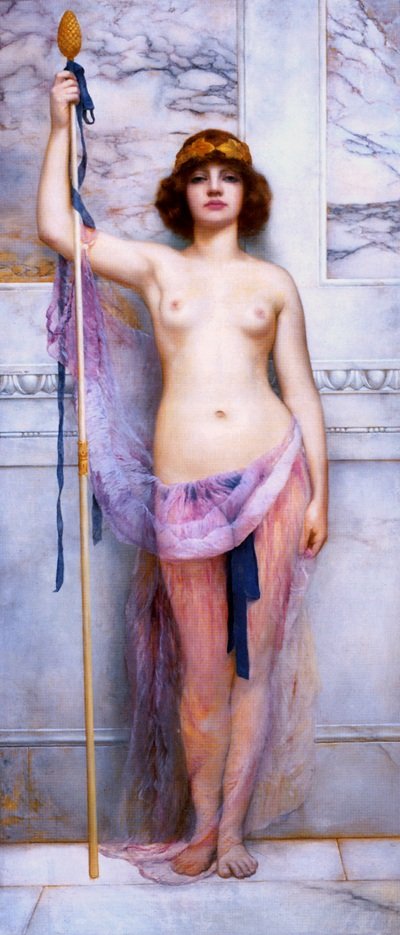
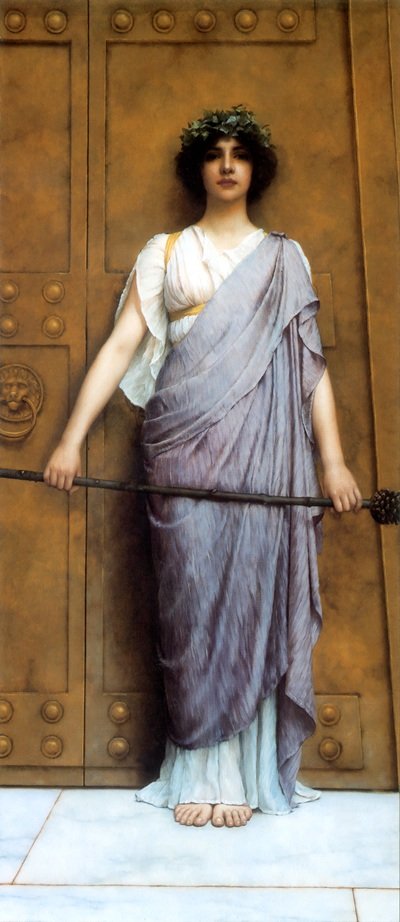
- A Priestess (1893): An early iteration exploring the classical theme, featuring Godward’s hallmark attention to flowing, vibrant drapery and intricate architectural backdrops
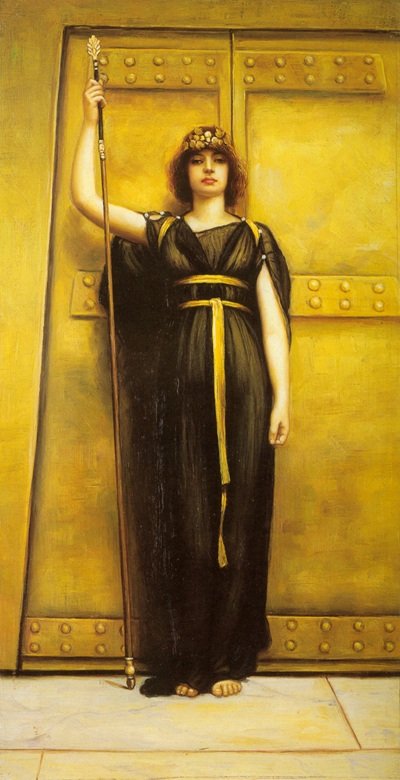
- The Priestess (1895): In this painting, a woman stands with a commanding presence in front of monumental temple doors. She is clad in ceremonial black robes accented with gold and holds a staff, symbolizing sacred authority in a bygone pagan world
- At the Gate of the Temple (1898): One of Godward’s finest masterpieces from the late 1890s. It depicts a solemn yet serene young woman standing erect and proud as she guards the entrance to a temple. In her hand, she holds a thyrsus—a staff topped with a pine cone. This symbol explicitly links her to a Bacchante, a priestess and follower of Dionysus (Bacchus), the god of wine and ritual ecstasy. The subject is believed to be modeled by Lily Pettigrew, a favorite model who frequently posed for Godward’s idealized classical depictions.


Notes
The comments above reflect only the thoughts the administrator had while viewing the images. They might or might not be comments by the artist, subjects or the photographers etc.. Please excuse any inaccuracies. You are welcome to leave comments in the comment space. Otherwise send messages to “kohi@scroll.kohibiz.com”.
Click the underlined titles. This will link you to the original site from which the images were taken including license information. We believe there is no problem with the image license. Most are in the public domain.
Most images are from Wikimedia Commons. If there are any problems please leave a message. Images will be taken down if necessary. Some images have been cropped from the original using the Vertical Scroller application program. This is to ensure the best viewing experience.