This post is composed of images of great art by the British painter Lord Frederic leighton (1830–1896). He painted historical, biblical, and classical subject matters in academic style. He was much in demand. His paintings appealed to the nostalgy and taste of Victorian Britain for the glorious “Golden Age” of ancient Greece and Rome. Enjoy !
This site attempts to make apparent the beauty hidden in images thru the site’s image scrolling function. This post in particular is a selection of images by great British painter Lord Frederic Leighton, President of the Royal Academy in London from 1878 to 1896.
Choose an image, It will expand and scroll view. You can click control tabs on the upper left corner of the screen. Depending on the tab, you can (1)fast scroll (skip button), (2)expand, (3)minimize, (4)shift right or left, (5)pause or (6)scroll up or down. You will see details not noticed in normal viewing. This will reveal beauty hidden from you before.
Some comments by the administrator of this site have been added. I believe a painting is more enjoyable when a person understands some of the history and circumstances behind each painting. Enjoy !
Leighton’s Biography
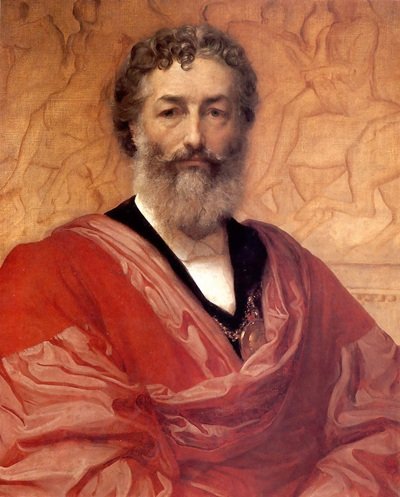

Frederic Leighton (1830–1896) was born in Scarborough, North Yorkshire, England. His grandfather, James Boniface Leighton was a physician to two Russian tsars, Alexander I and Nicholas I, He amassed a fortune. His son also became a physician. Because of this, Frederic and his wealthy, well to do physician family were never in need. Frederic was 12 when his grandfather died in 1843. His father retired soon after and started travelling in Europe probably because of his wife’s health. First Paris, then Germany, then Italy, then back to Germany. The young Frederic became a natural linguist, French, German, Italian. When the family was in Florence, he was instructed by the Ameican sculptor Hiram Powers. In 1849, when the family moved back to Frankfurt, he studied extensively under Johan Edward Steinle. In 1851 the family returned to London. Frederic was 21. He was independent, he travelled abroad independently. He made the aquaintence of lifelong friend of Adelaide Sartoris the opera singer, and joined her circle. Thru that circle he met Thackeray the novelist, George Sand mistress of Chopin and feminist writer, Gérôme the historical genre painter, Adolphe-William Bouguereau (1825-1905) the great 19th century French painter etc. In this manner he became friends with some of the most influential people of that time. He also started his art career at that time. His famous Cimabue’s Celebrated Madonna was bought by Queen Victoria in 1855. In 1858 Leighton showed The Fisherman and the Syren. a beautiful painting featuring a sexy syren. The 1860s (he was in his 30s) were his productive years. In 1860, he moved to London where he associated with the Pre-Raphaelites. In 1864 he became an associate of the British Royal Academy. He journeyed to Egypt multiple times, sometimes solo, sometimes with his mentor Adelaide Sartoris, one time with Ferdinand de Lesseps (1805-1894) the originator, and the prime mover in the construction of the Suez Canal. Frederic was basically a Victorian artist who liked to portray idealized Roman, Greek, biblical subjects in academic style but after trips to Egypt, Frederic’s Odalisque, The Egyptian Slinger and The Moorish Garden show oriental influence. He worked hard. In 1878 when he was still in his 40s Frederic became president of the British Royal Academy. In the 1780s he met Dorothy Dene an artist’s model and actress. This lead to many paintings. It is said she featured in many of his paintings. Flaming June, Captive Andromache, The Garden of the Hesperides, The Bath of Psyche, Crenaia, the Nymph of the Dargle, etc.. In1896, Frederic’s ennoblement was announced, he became Baron Leighton of Stretton but died that same year.
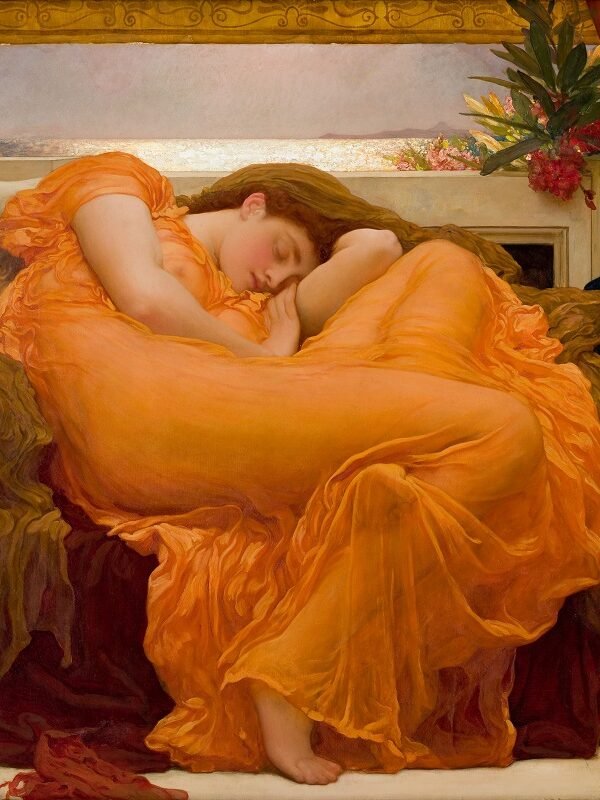
His last Painting “Flaming June”
.jpg)

Flaming June was completed in 1895, just one year before the death of the painter, the renowned Frederic Leighton, president of the British Royal Academy. It is said to be his most celebrated painting. A masterpiece of Hight Victorian art, an example of the aesthetic movement which celebrated art for art’s sake, beauty for beauty’s sake, with minimal narrative support to explain the work’s relation to external matters. For example the woman in Flaming June is unnamed, she is just a young and beautiful woman, anonymous. Not Venus goddess of love or Cleopatra queen of Egypt. Calling her that could have provided support, added unwanted history to the painting. But Flaming June was so beautiful and expressive that such props were unnecessary.
In the painting, we immediately see that the woman is young and beautiful, her pink face shows the air is hot, maybe from the summer heat. We can also infer this from the painting’s title which is “Flaming June”. Her eyes are closed in sleep, she is alone. So it is not presumptious to take time to watch her intently. Her curvaceous body is covered in diaphanous orange cloth which allows us to glimpse the peaks of her breasts, the voluptuous curves of her limbs. The painting presents a classical Mediterranean air but on the right side there is a poisonous oleander plant. This hints that sleep might transition easily to death. Sleep is not so different from death. This can also be viewed as a reference to “femme fatale”, a popular theme in Victorian art. A “femme fatale” embodied beauty, mystery, seduction, and danger. In Victorian art she often entraps a man into her web of deceit and ruins him. A reminder that women are difficult beings, not to be trifled with.
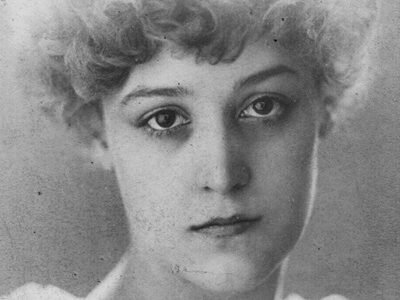
The model is said to be Dorothy Dene, an English stage actress and artist’s model. Frederic seems to have regarded her as “the perfect woman”. She appears in many of his paintings. Her birth name was Ada Alice but she changed it to Dorothy Dene. The surname “Dene” was chosen by Frederic. She came from a family of six, she lived with her sisters in an apartment in South Kensington, London. Frederic assisted her in her acting career. It is said that she was in a romantic relationship with him, but this is unconfirmed. Frederic must have liked her. When he died he left her £5,000, plus another £5,000 in trust for herself and her sisters.
The painting was celebrated at the time of creation but disappeared in the 1930s. It was rediscovered in the 1960s. In 1963, a politician from Puerto Rico purchased it in Amsterdam for less than $1,000. An unbelievably low price. Painting from the Victorian era were unpopular in the 1960s. There is some mention that Victorian art at that time was called Victorian junk. Even this superb painting, created by one of the premier painters of the Victorian era could be classified in this manner. This points to the fact that the value of art is subjective. based on personal feelings, tastes, opinions, or biases of the times etc..
However now, it is the centerpiece artwork in the Museo de Arte de Ponce in Puerto Rico. In 2016 it was loaned to the Leighton House Museum in Kensington, England and displayed in the studio where it was created.
The Women paintings
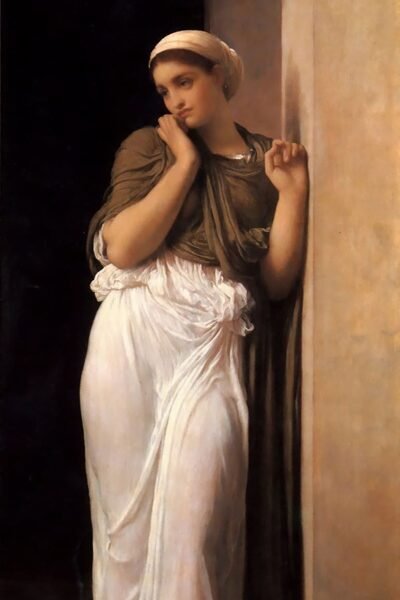
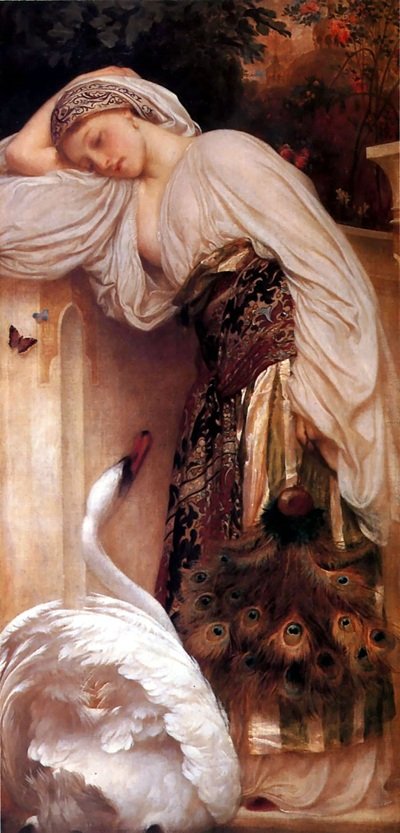
- Nausicaa (1879) : Nausicaa is a figure in Greek mythology from Homer’s Odyssey. Odysseus was shipwrecked. Nausicaa princess of Scheria is playing on the seashore with her handmaidens. She finds Odysseus naked. She gives him some clothes and guides him to the palace. In the story Nausicaa is a young kind beautiful maiden. Odysseus even likens her to the the goddess Artemis. Nausicaa is smitten also and tells friends that she would like her husband to be like him. However Odysseus has to go on with his quest. This is a story of unrequited love, In the painting she leans against a column of her father’s palace at Ithaca and watches earnestly for the return of Odysseus. She has a wistful look as she gazes at the wide sea.
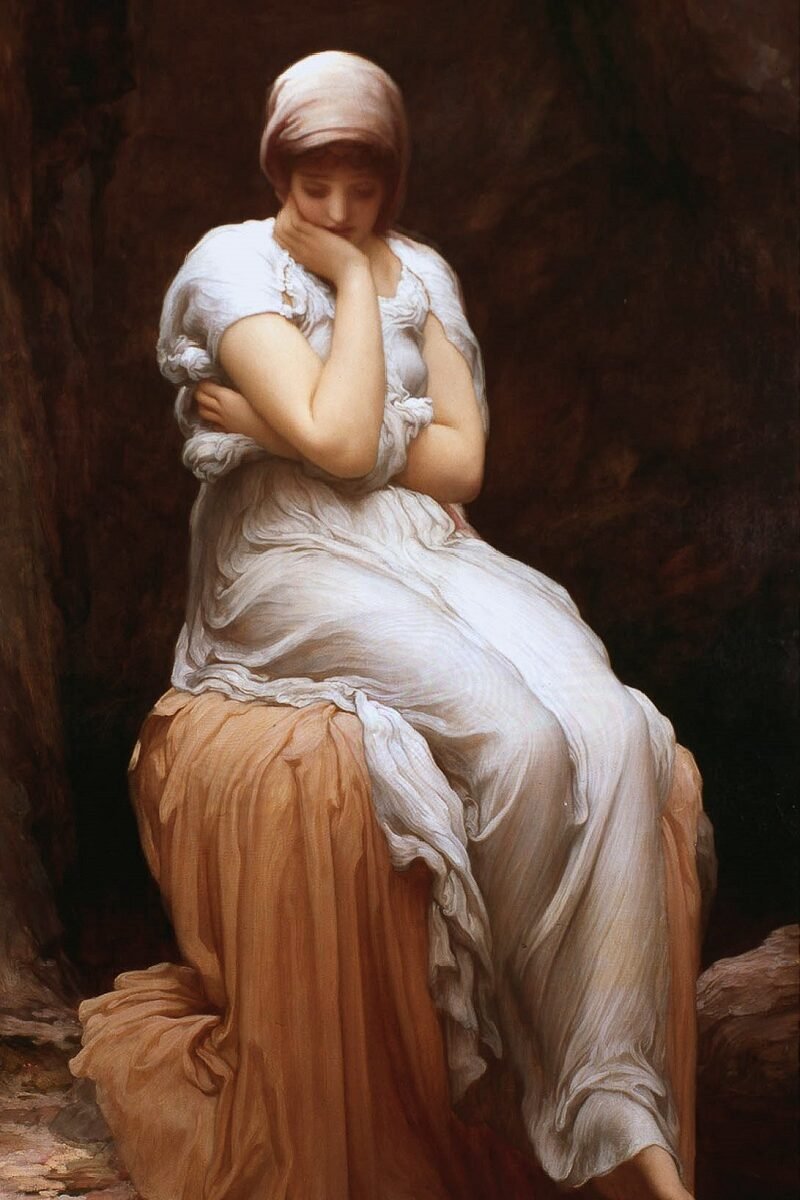
- Solitude (1890) : This painting is an example of Victorian “Aestheticism”. The focus is on mood, beauty and emotions. A lovely young woman sits in solitude in deep contemplation. You can almost touch her sense of lonelyness.
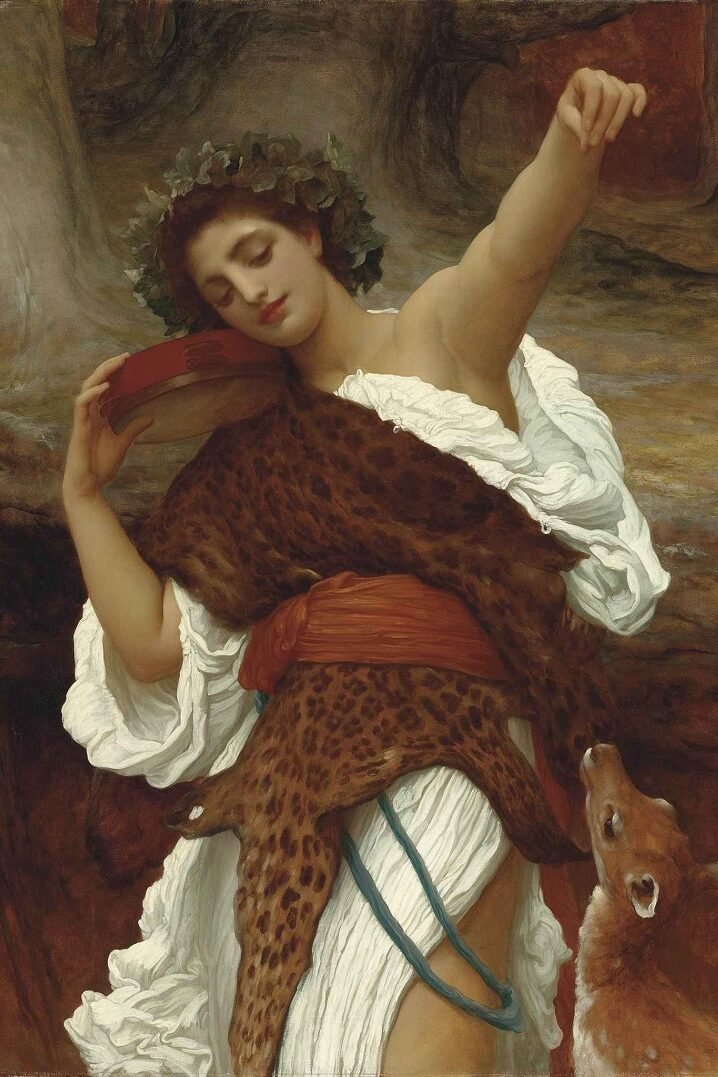
- Bacchante : An image of a Bacchante, a female follower, priestess of the Roman god of wine, Bacchus. A Bacchante is usually pictured as a woman in frenzied, ecstatic or drunken state. She has vine leaves or grapevines in her hair.
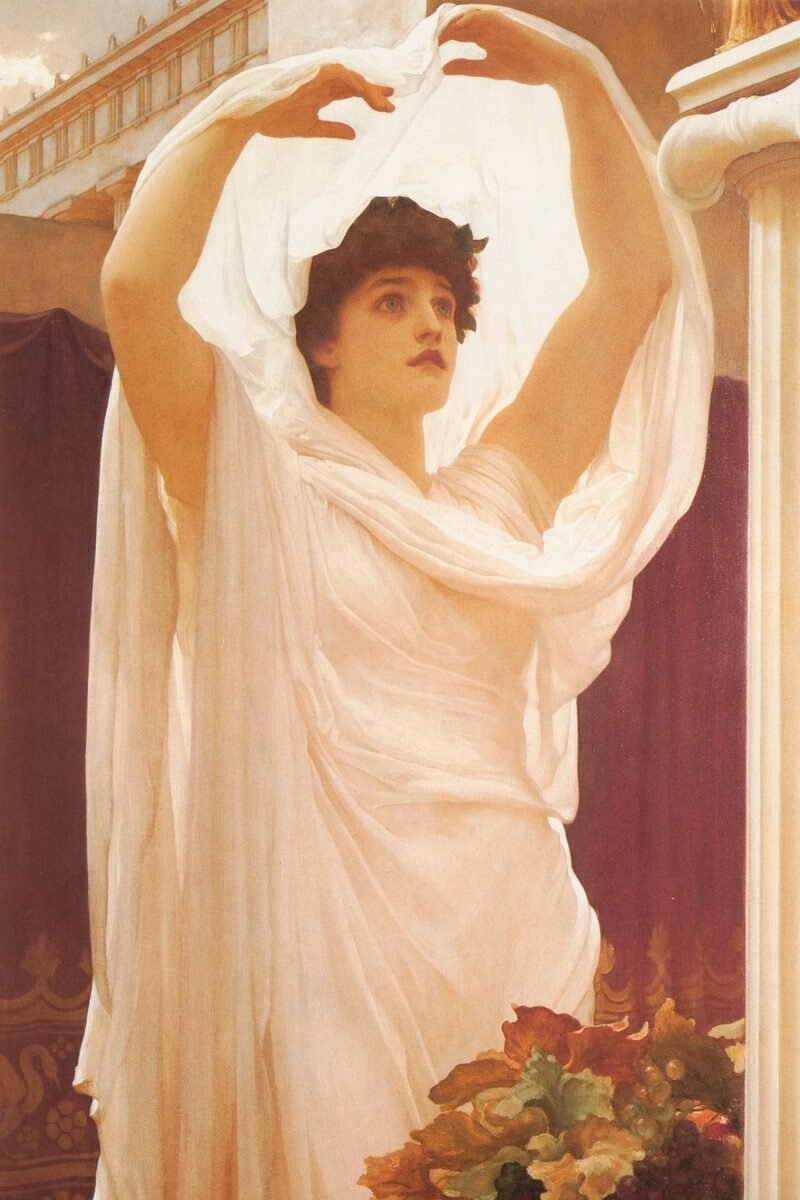
- Invocation (1889): An aesthetic painting in the Neoclassical style. The painting is celebration of a beautiful female form, soft and harmonious draped in white cloth that shows glimpses of her body. She is a lovely worshiper looking up. In a classical setting. “Invocation” implies a prayer or a summoning.
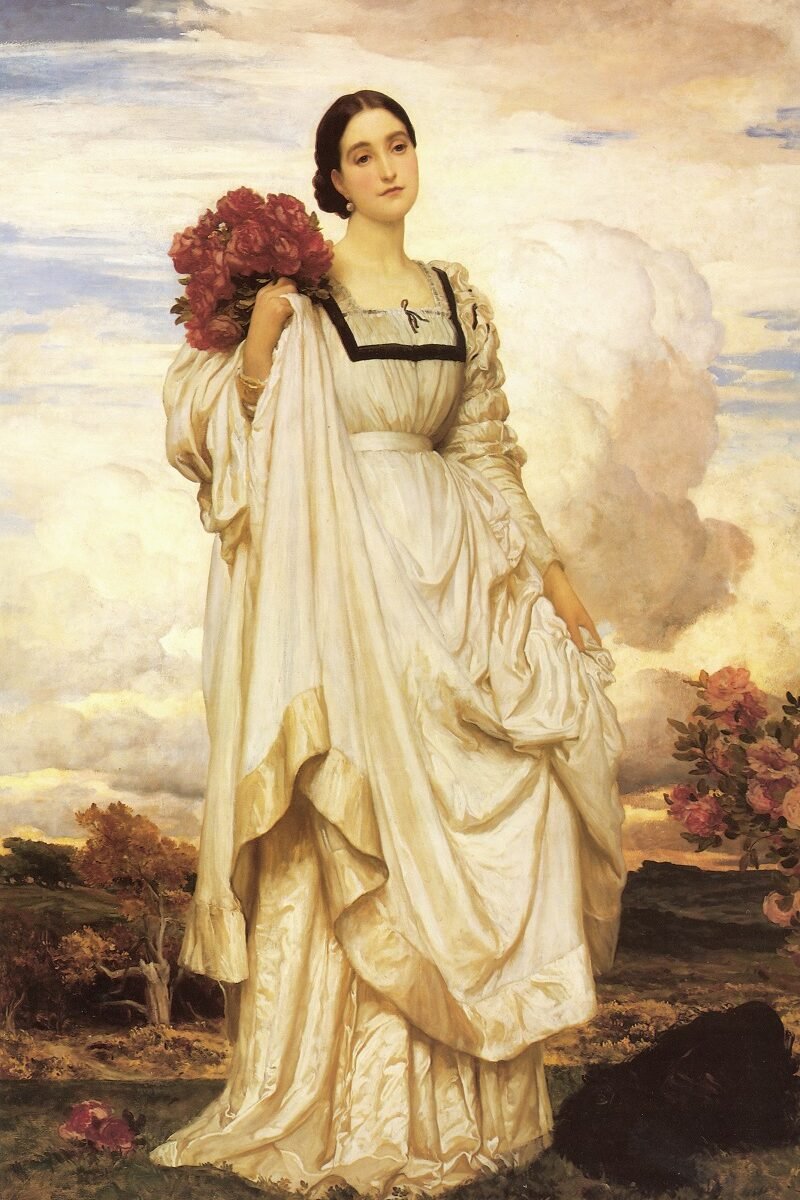
- Lady Adelaide Chetwynd-Talbot (1879): A likeness of Lady Adelaide Chetwynd-Talbot, Countess Brownlow (1844-1917). She was the youngest of three daughters of Henry John Chetwynd-Talbot, 18th Earl of Shrewsbury.


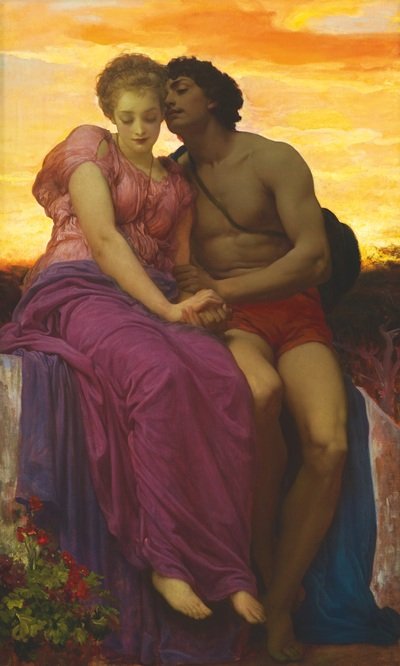
- Whispers (1881) : An aesthetic painting showcasing a sensuous moment. a study in “ideal beauty” in the Victorian style. Two young lovers are highlighted in a chaste, intimate moment. The superb composition, a woman in satin drapery that emphasizes her womanly figure against an orange sky is typical of master painter Frederic Leighton.
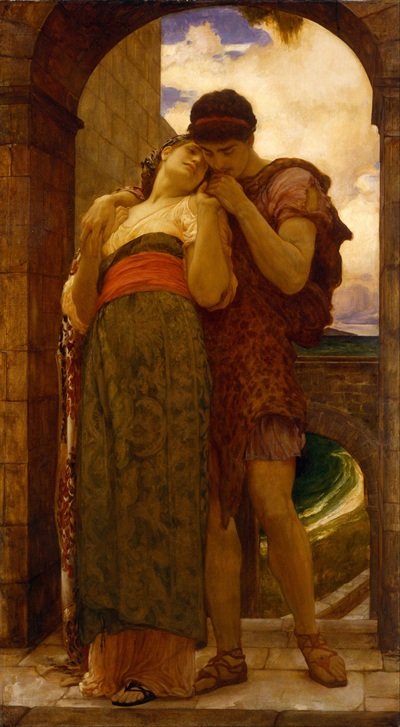
- Wedded (1882) : This is often compared with the previous “Whispers”. It is an aesthetic painting. It celebrates passionate love between man and woman. A moment of intense affection, loyalty, and passion. Maybe they have just married and are on the threshold of a new life. The scene is set within the Greek amphitheatre of Taormina in Sicily. It features classical architecture and the sea. This reflects Leighton’s love for ancient art and culture.
- Odalisque (1862) : An odalisque was a female slave or concubine in a Turkish harem, basically in the Ottoman sultan’s household. In 19th-century European art, painting an odalisque was a socially acceptable way for European artists to explore the Orient and the female nude. This is exactly what Frederic Leighton did. He was following artistic trends in Italy and Paris and in this case he focused on the “Orientalist” theme popular at that time.
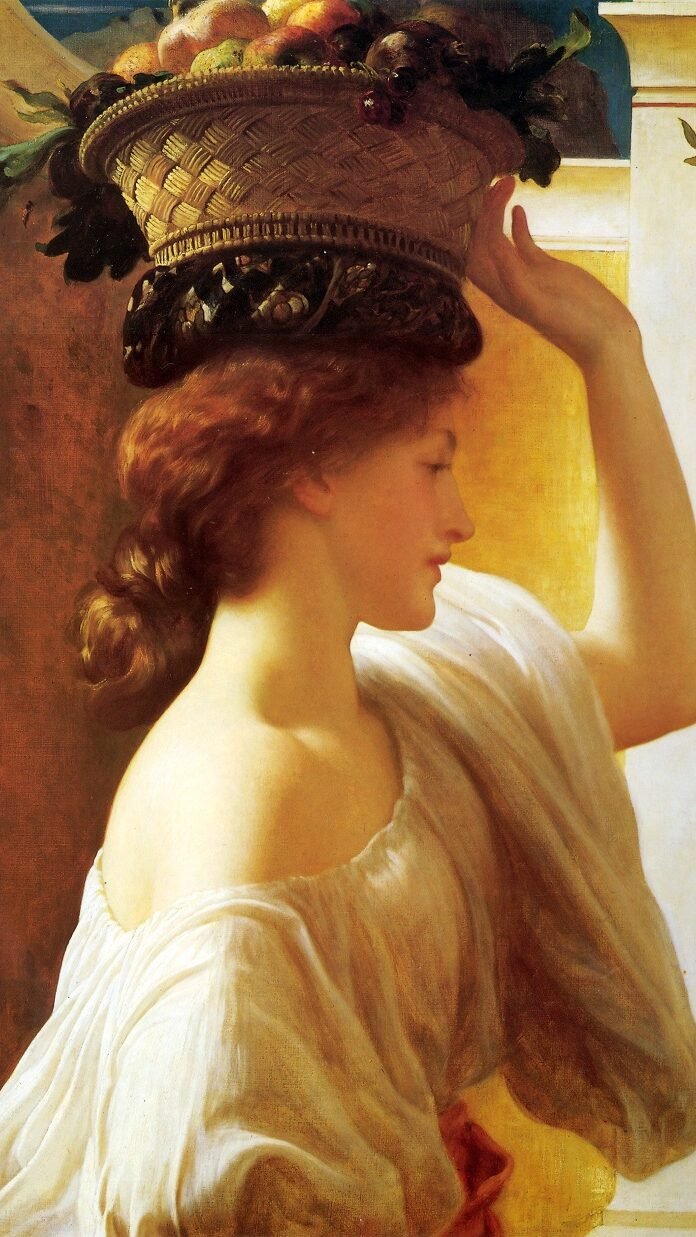
- Girl with a basket of fruit (1863) : The girl’s name is “Eucharis”, an imaginary nymph from Fenelon’s 1699 novel “Adventures of Telemachus”. This was a novel which incorporated Greek heros from the Odyssey such as Odysseus and his son Telemachus. However the painting itself is part of the 19th-century Aesthetic movement. It celebrated art for art’s sake, beauty for beauty’s sake. It does not focus on the narrative. The the focus is on the classical beauty of the girl, the serene mood, and rich color. Art for art’s sake, beauty for beauty’s sake.


The Leighton nudes
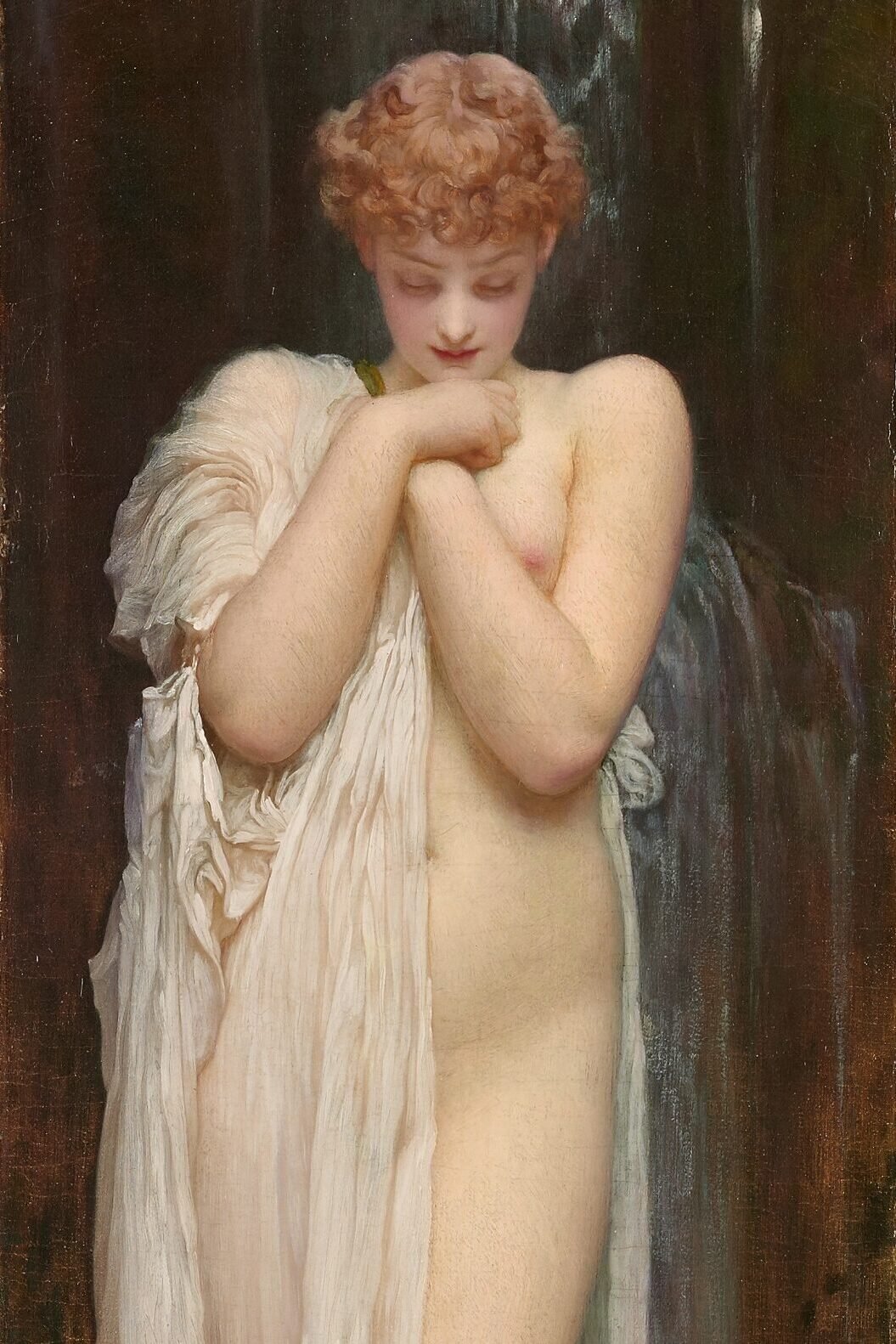
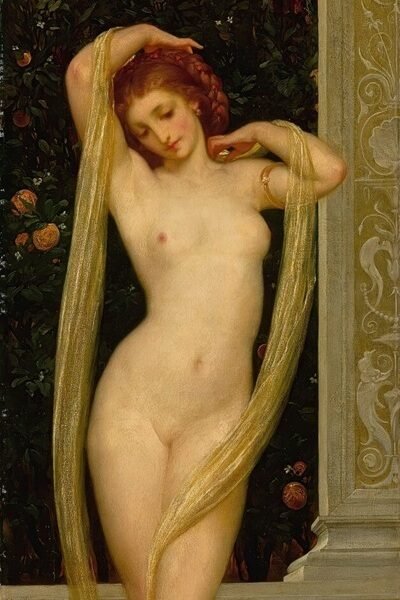
- Crenaia, the Nymph of the Dargle (1880) : The model is Frederic Leighton’s favorite muse, Dorothy Dene. She is reconizable because of the little curls on her head and her distinct, well-defined facial characteristics, such as a prominent jawline and high cheekbones. Crenaia in the painting is a nymph, risen from the waters of the River Dargle in Ireland. It ran across the estate of Lord Powerscourt who was a peer of Ireland, an enthusiastic art collector and the first owner of the painting.
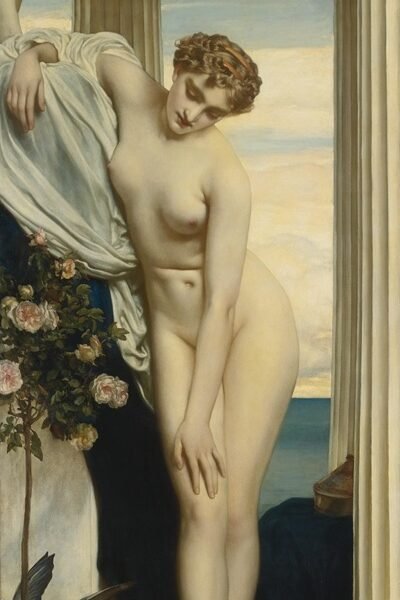
- .Venus Disrobing for the Bath (1867) : This features a life-sized female nude representing the goddess Venus depicted in a vertical, slender format. It highlights Leighton’s focus on classical beauty and the body. This was a key work in developing the aesthetic “art for art’s sake” movement in Britain which focused on the beauty of the human form rather than just the narrative.
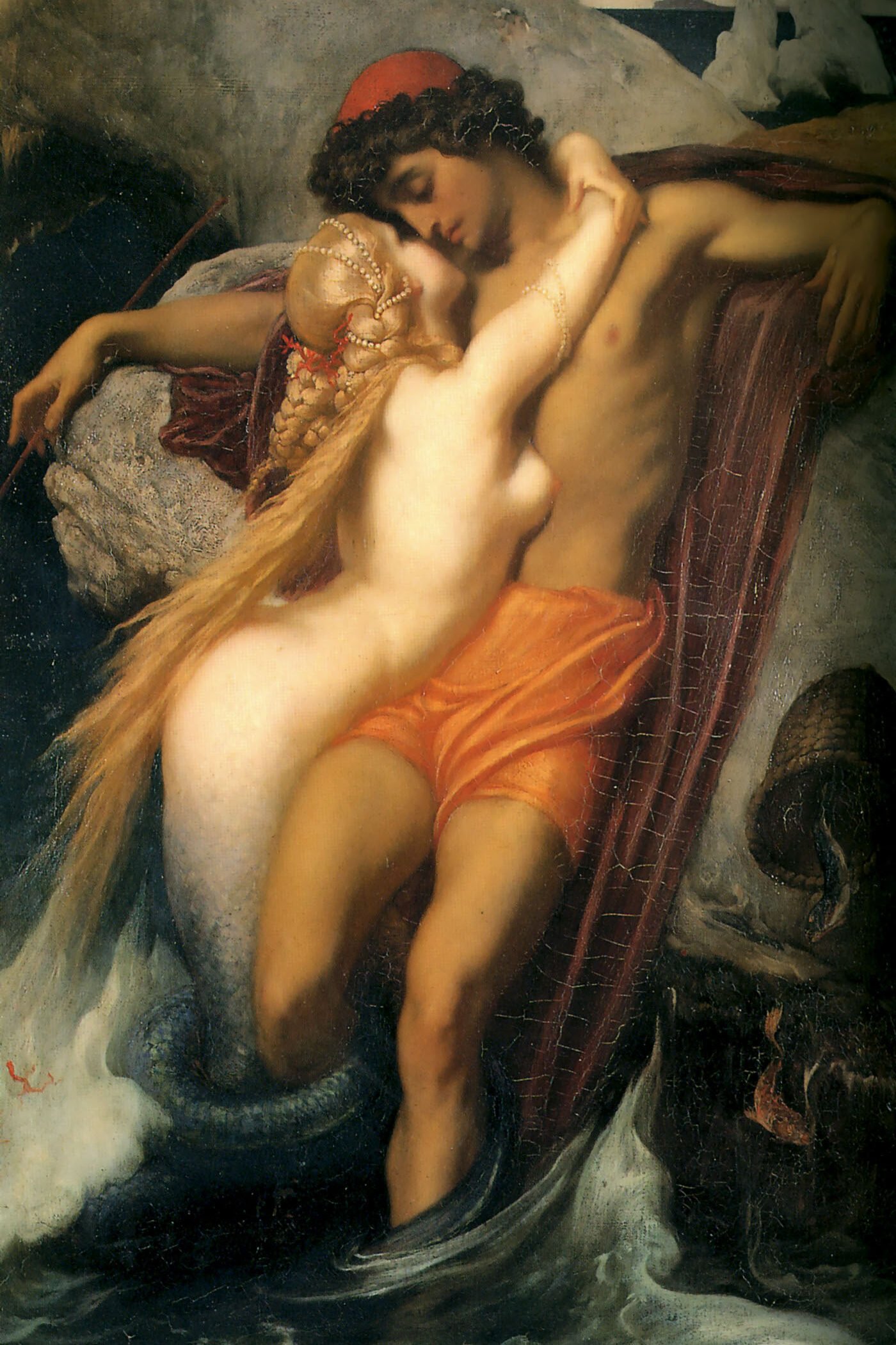
- The Fisherman and the Syren (1856-1858) : This was created early in Leighton’s career (26-28 years old) and shows (1)his skill in depicting the human form, (2)his interest in classical and mythological subjects and (3)a Pre-Raphaelite influenced academic style. The painting itself shows a mythical syren luring a fisherman into the sea to his doom. This was a popular 19th century theme. It can be seen in “The Siren” by William Waterhouse. The narrative comes from a poem by Johann Wolfgang von Goethe.
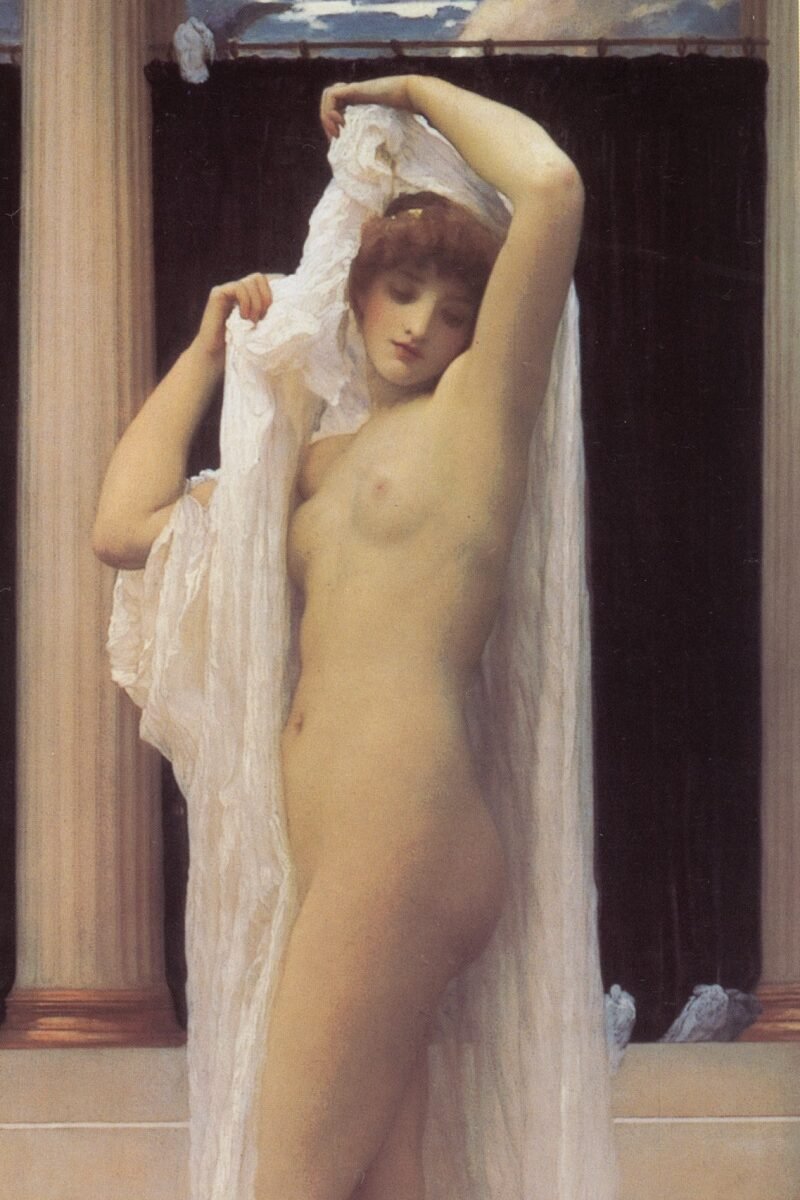
- The Bath of Psyche : Psyche beauty without peer, lived in the palace of Cupid, the god of love. Each night Cupid would visit Psyche and lie with her under cover of darkness. This hid his identity. In the painting, Psyche is undressing to bathe in preparation for Cupid’s visit. She is absorbed in the pleasurable inspection of her own person. It is said the composition was influenced by the nudes of Ingres, such as “The Source (The Spring)“.
- Venus And Cupid : A standing female nude in classical style, This depicts the goddess of love Venus. Her son Cupid is at her feet. This is an exploration into the themes of sensuality and classical mythology,


Middle Age, Biblical Themes
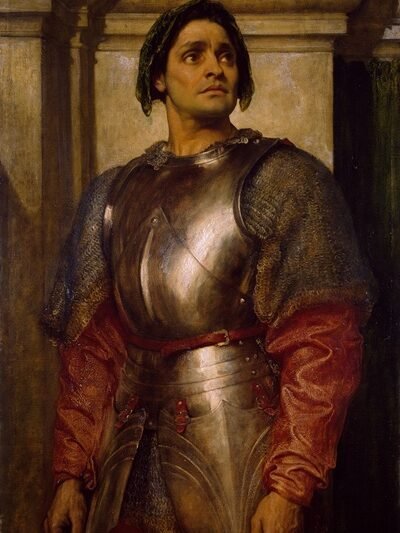
- A Condottiere (1871) : This is an example of Victorian-era classical style oainting and is often described as one of Leighton’s strongest portrait examples. It depicts a focused, armored soldier, an Italian condottiiere looking away from the viewer. It captures a moment of quiet contemplation or stern command. Power and authority radiates. A condottiere is a mercenary leader from the 14th to 16th centuries. They were contracted by Italian city-states such as Florence, Venice, and Milan to conduct wars, shaping the conflict and politics of the Renaissance.
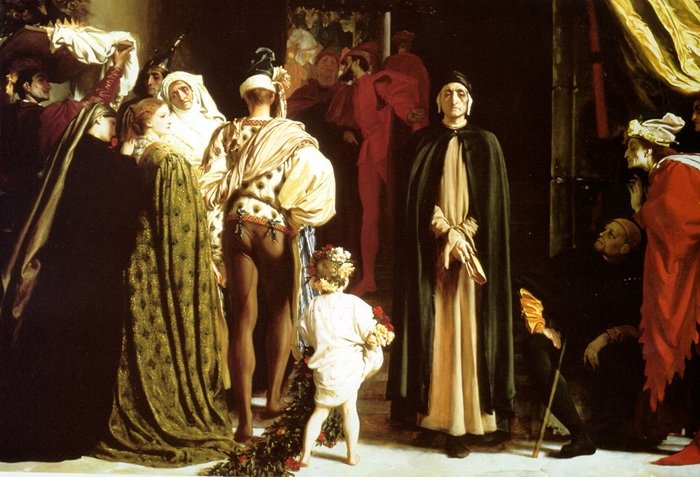
- Dante in Exile (1864) : This is a history painting and shows the famous 14th century Italian poet and politician Dante Alighieri exiled from Florence. Dante wears a dark tunic and stands with a melancholic expression, This contrasts sharply with the vibrant and ornate attire of the other figures arround him. This drives home the fact that Dante is in exile, he in disconnect. Leighton a leader of Pre-Raphaelite movement and later of the Victorian style conveys the depth of personal suffering through his masterful use of color, light, and form.
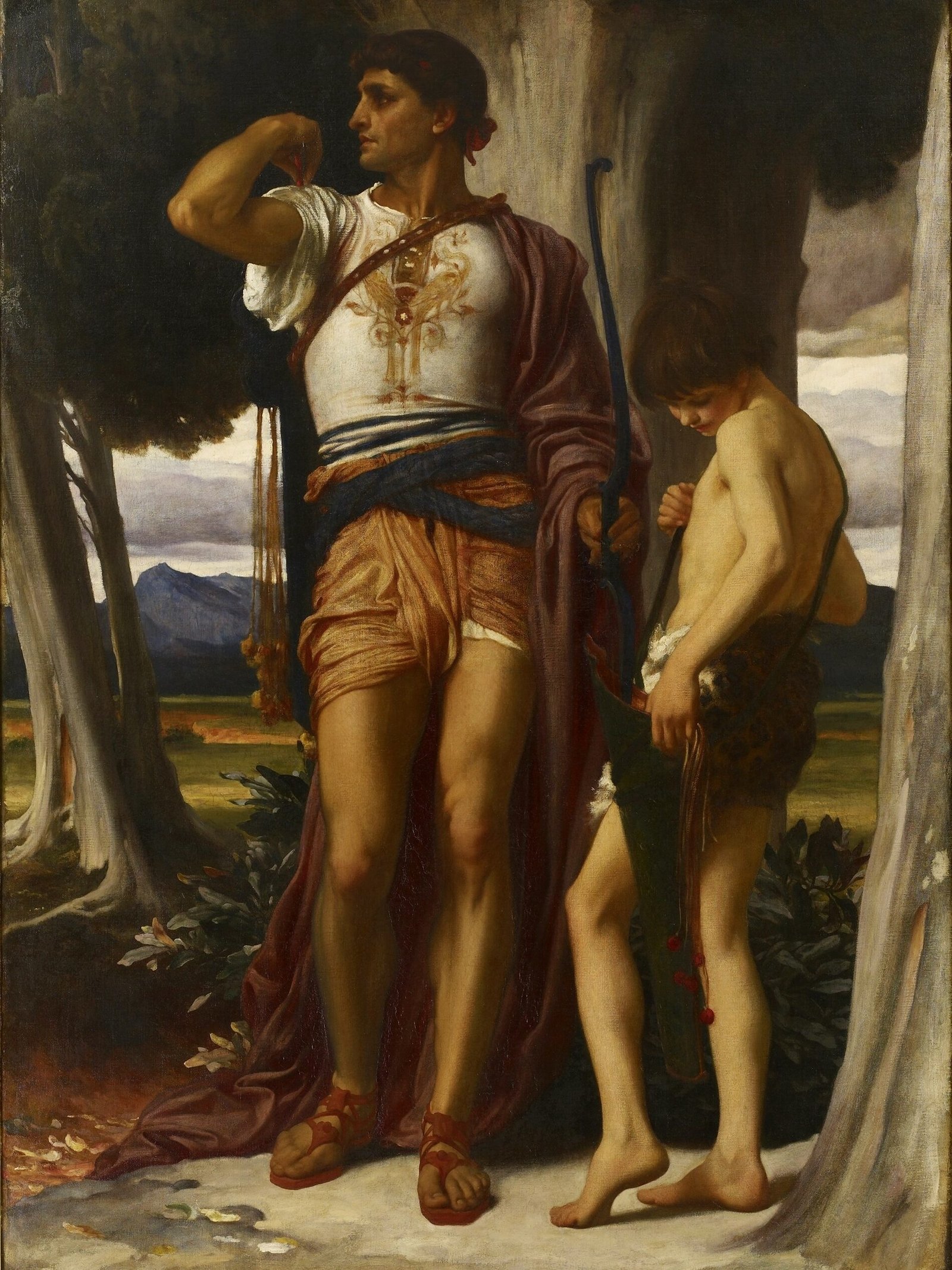
- Jonathan’s token to David (1868) : This is from the old testment.The prophet Samuel appointed David as King Saul’s successor, but Saul becomes jealous. He plotted David’s death. In the painting David’s loyal friend Jonathan (Saul’s son) is giving David a token as a symbolic pledge of loyalty, friendship, and protection. This highlights the heroic bond between two biblical heros.

.jpg)

The Others
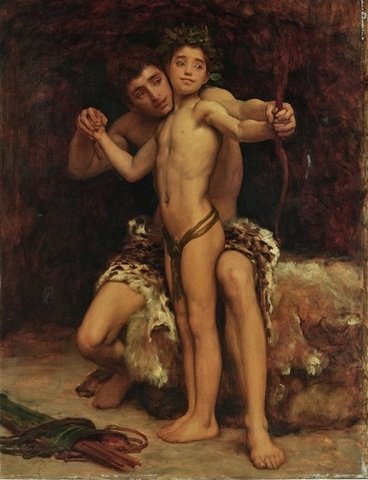
- The Hit : Two nude male figures are presented. A youth and a boy. It celebrates themes of manliness and mentorship.
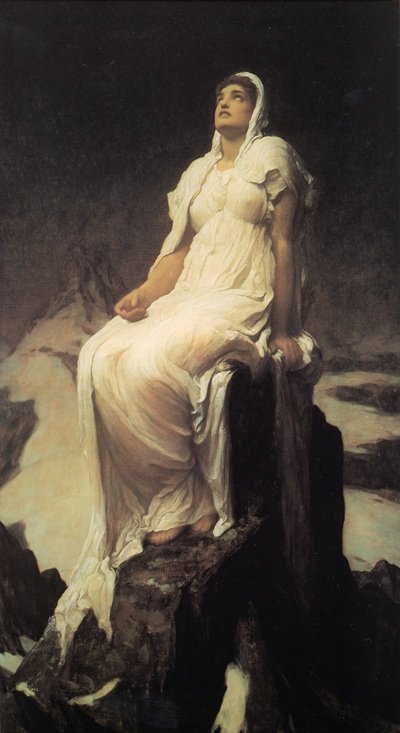
- The Spirit of the Summit (1894) : A draped female figure sits on a rocky, snow-covered peak. This symbolizes the purity of the human spirit, refined, isolated, and reaching toward eternity. The model is Leighton’s favorite model Dorothy Dene. The landscape is in Zermatt, Switzerland, 1893. It is in Academic style and was created in the latter part of Leighton’s life.
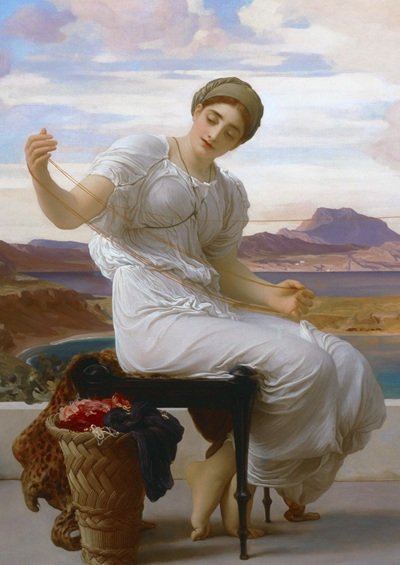
- Winding the skein — detail from left side (1878) : A classical, idyllic scene of two figures winding wool on a terrace overlooking the bay of Lindos, Rhodes, in Greece. This is a Victorian idealization of everyday domestic life.
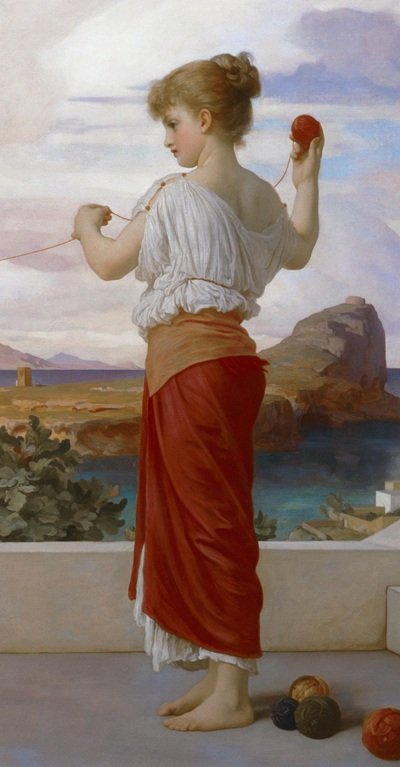
- Winding the skein — detail from right side (1878) : This is the right side of the painting above.
.jpeg)


Notes
The comments above reflect only the thoughts the administrator had while viewing the images. They might or might not be comments by the artist, subjects or the photographers etc.. Please excuse any inaccuracies. You are welcome to leave comments in the comment space. Otherwise send messages to “kohi@scroll.kohibiz.com”.
Click the underlined titles. This will link you to the original site from which the images were taken including license information. We believe there is no problem with the image license. Most are in the public domain.
The images are from Wikimedia Commons. If there are any problems please leave a message. Images will be taken down if necessary. Some images have been cropped from the original using the Vertical Scroller application program. This is to ensure the best viewing experience.