This post is a series of images featuring the art of the great Neoclassical painter Jacques-Louis David (1748–1825) France. Enjoy !
This site attempts to illuminate beauty hidden in images thru the site’s image scrolling function. This post in particular is a selection of images of paintings in the 18th or 19th century by the premier Neoclassical painter Jacques-Louis David. Find the beauty concealed in the paintings !
Choose an image, It will expand and scroll view. You can click control tabs on the upper left corner of the screen. Depending on the tab, you can (1)fast scroll (skip button), (2)expand, (3)minimize, (4)shift right or left, (5)pause or (6)scroll up or down. You will see details not noticed in normal viewing. This will reveal beauty hidden from you before. Enjoy !
Biography

Jacques-Louis David (1748–1825) is considered the number one French painter of the 18-19th century. He painted in Neoclassical style. The contrast between the earlier Rococo style is striking. The Rococo was beautiful, frivolous and often depicted French aristocrats living a dream life of luxury such that only a few could aspire to. In contrast Neoclassicism was serious, moralizing and embraced the order and logic of classical antiquity.
David lived in (1)the final years of the Ancien Regime which lead to the abolishment of the French monarchy, (2)the French Revolution, (3)the era of Emperor Napoleon and (4)the Bourbon revival which reestablished the French Monarchy. It was a tourbulent time and David, an eminent painter was caught in the flow. He supportrd the French Revolution and paintings like “Oath of the Horatii”,”The Death of Socrates”, “The Lictors Bring to Brutus the Bodies of His Sons” which extolled the virtues of Enlightenment, self sacrifice for the good of the state over the traditional values of the Ancien Regime. He greatly influenced the French populace. He then aligned himself with Napoleon creating multiple paintings such as “Napoleon Crossing the Alps” and “The Coronation of Napoleon”. After Napoleon’s fall from power, he exiled himself to Brussels, then to the Netherlands where he stayed until he died. His final painting is “Mars désarmé par Vénus”.
Early Portraits; David aged 21-27

- Madame François Buron (1769)
- Jacques-Louis David (1748–1825)
- The subject is Madame François Buron, wife of David’s uncle and one of his early supporters.


- Mademoiselle Guimard as Terpsichore (1773~1775)
- Jacques-Louis David (1748–1825)
- Guimard was a French ballerina. During the reign of Louis XVI, a star of the Paris Opera.

The Death of Seneca (1773); David aged 25
Choosing to die and follow orders even if the order is unjust. This is the theme.
This painting shows the death of Seneca, a Roman philosopher. Seneca was unjustly ordered to die by Nero the Roman emperor, but he accepts his fate and chooses to die by cutting his arms. His friend and doctor Statius Annaeus gives him some medicine to ease his suffering. His wife Paulinna on the right tries to follow him in death but is prevented. There is a centurion sent by Nero to confirm his death and a disciple taking down his last words.
The painting has some Rococo qualities such as the frivolous dress of Seneca’s wife. This is in stark contrast to the gravity of the situation.
Also note the role of the two main characters. The stoic man who follows orders and the distraught woman who cannot hold back her tears. This was a common thread in many of David’s paintings.
Credit : the death of Seneca


Click to scroll view left side

Click to scroll view right side
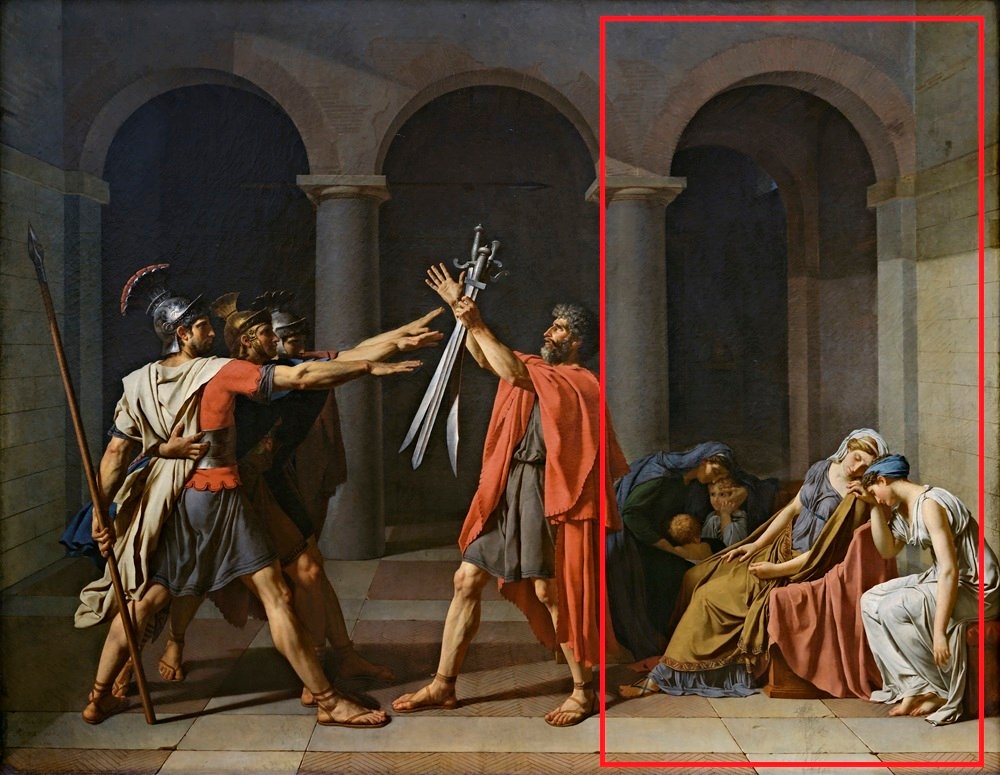
Oath of the Horatii (1784~1785); David aged 36-37
One of the most famous paintings in the Neoclassical style. The frivolity apparent in “The Death of Seneca (1773)” which leaned to the Rococo style has been replaced by the seriousness, strict adherence to order and logic which characterized the Neoclassical style. It was commended by the French king Louix XVI and was a great success that launched David’s career.
It was created 5 years before the French Revolution and reflects the mood of the time well. Thus the basic theme is sacrifice of self for the good of the state where the state represents reason as opposed to the traditional “Ancien Regime” in France.
This harkens to the story in 7th century BC of two cities at war, Rome and Alba Longa. The cities decide to settle the war by each sending 3 men to fight. Whoever survives wins the war. Three brothers from a Roman family, the Hoaratii fight three brothers from Alba Longa, the Curiatii. The scene in the painting depicts the Horatii brothers stretching their arms to their father, promissing victory. War is not just patriotism, it is about sacrifice. On the right is Camilla, sister of the Horatii. She weeps because she loves one of the Curiatii brothers. If Rome wins, she looses her lover, if Alba Longa wins she looses her brothers. In the end Rome wins and she is killed by her brother for weeping over her Alba Longa lover.
Credit : Oath of the Horatii


The Death of Socrates (1787); David aged 39
The theme is Enlightenment, the triumph of the enlightened spirit over the body. In this painting, Socrates the philosopher rises above the limits of his body and turns to his teachings.
Enlightenment in the 17th-19th century, was a European concept emphasizing reason and individualism over tradition. It can be said that Enlightenment lead to the French Revolution, democracy, liberty and the constitutional government of modern times.
The painting highlights the stoic demeanour of the great Greek philosopher Socrates even when facing death by poison. Socrates has been sentenced to death for spreading inflammatory teachings. He is reaching for the poison with his right hand, yet he still raises his left hand to teach his disciples. Plato, the other great philosopher sits on the edge of the bed in somber sorrow. In the background Socrates’ wife looks on. She has been dismissed and glances back wistfully.
Credit : the death of Socrates


Click to scroll view left side

Click to scroll view right side
The Lictors Bring to Brutus the Bodies of His Sons (1789); David aged 41
The same basic theme as in the previous painting. The triumph of reason over emotion, duty over self. In the painting, the Roman politician Brutus, founder of the Roman Republic, broods over the fate of his sons. They tried to overthrow the republic and Brutus had to kill them. Brutus defended the republic at the cost of his own sons. In the background his wife and daughters mourn.
This painting was made public arround the time the French Revolution (1789) began. Thus the painting’s basic theme which celebrated the Roman Republic resonated tremendously with the public. There was fear among the authorities that it might inflame pro-revolutionary passions. So it was almost not exhibited in the Salon.
Credit : The Lictors Bring to Brutus the Bodies of His Sons


Click to scroll view left side

Click to scroll view right side
The Intervention of the Sabine Women (1799); David aged 51
The theme is love over conflict and the protection of children. This was painted after the French Revolution and can be interpreted as a call to the people to re-unite after the devastation of the revolution.
In the painting, Titus, leader of the Sabines clashes with Romulus of Rome. The woman in the middle is Hersilia, daughter of Titus and wife of Romulus. She interposes herself and her children between Romulus on the right with a spear and Titus on the left.
Credit : The Intervention of the Sabine Women


Click to scroll view left side

Click to scroll view right side
Napoleon Crossing the Alps; David aged 52
One of the most famous portraits of Napoleon. Napoleon had just taken power in France in a coup and become First Consul. But the Austrians were laying siege to Masséna in Genoa. Napoleon had to react quickly and consolidate. He led the French reserve army through the Apls using the great Saint-Bernard Pass. He hoped to surprise the Austrians by taking this pass. This resulted in a decisive victory at the Battle of Marengo cementing his position as First Consul. The paintings below show the critical moment, Napoleon leading his army through the Alps. The victory lead to a rapprochement between France and Spain and the painting below on the left by Jacques-Louis David was commissioned by Charles IV of Spain to hang in the Royal Palace of Madrid. It was a political painting signaling friendship between France and Spain. It shows Napoleon glorified; on a white stallion, in the uniform of a consul. It was created in 1800. 40 years later in 1850 Paul Delaroche created a more realistic painting (image below on the right) where Napoleon rides a mule through snow and is guided by an old guide. This is nearer the truth but still glorifies. Napoleon crossed the Alps in fair weather. The two paintings illustrate the pride the French took in Napoleon’s vicory. Even after 40 years had passed painters were still creating paintings on the same theme.

- Napoleon Crossing the Alps (1800)
- Jacques-Louis David (1748–1825)
- This painting glorifies Napoleon. He actually crossed the Alps on a mule but this painting shows him in heroic pose striding a stallion in the uniform of the First Consul.


- Napoleon Crossing the Alps (1850)
- Paul Delaroche (1797–1856)
- This is said to be a realistic painting. Napoleon rides a mule, is lead by an old guide through snow. Delaroche produced this in 1850.

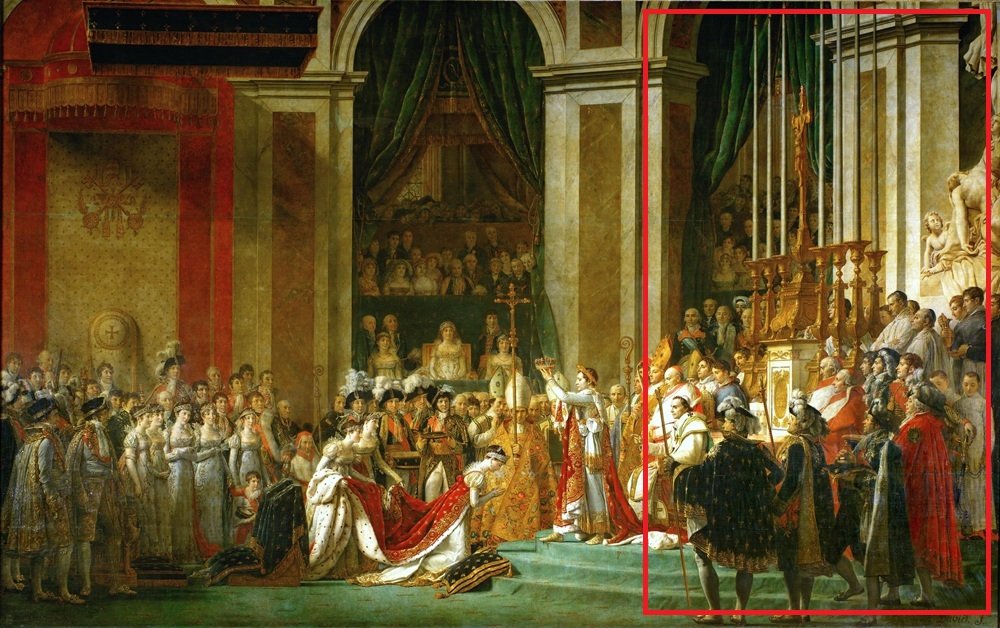
The Coronation of Napoleon (1805-1807): David aged 57-59
This was commisioned by Napoleon Bonaparte who became Emperor in 1804 and is meant to glorify Napoleon and the Napoleon Dynasty. Napoleon is in the center in robes similar to the emperors of ancient Rome. He holds a crown that he places on the head of his wife Joséphine de Beauharnais. The Pope Pius VII just stands there giving his blessing to the ceremony. Napoleon’s mother is in the stands but she is in a better position than the pope. Napoleon’s brothers are also there. Louis Napoleon, King of Holland, Joseph Napoleon, King of Naples. His sisters also in the front.
Credit : The Coronation of Napoleon
.jpg)


Mars désarmé par Vénus (1824); David aged 76
Davis’s last painting. Mars the god of war is in a temple in the clouds. Venus the goddess of love and her minions, Cupid and the 3 Graces take away his helmet, shield. He does not object, he succumbs to the goddess of love. In previous paintings, Davis had often portraided men as the bastions of strength and determination. Here he portrays women as the winners. Love conquers all, femininity conquers masculinity.
Credit : Mars désarmé par Vénus


Notes
The comments above reflect only the thoughts the administrator had while viewing the images. They might or might not be comments by the artist, subjects or the photographers etc.. Please excuse any inaccuracies. You are welcome to leave comments in the comment space. Otherwise send messages to “kohi@scroll.kohibiz.com”.
Click the underlined titles. This will link you to the original site from which the images were taken. We believe there is no problem with the image license. Most are in the public domain.
The images are from Wikimedia Commons. If there are any problems please leave a message. Images will be taken down if necessary. Some images have been cropped from the original using the Vertical Scroller application program. This is to ensure the best viewing experience.