This post is a series of images featuring art works by the great Japanese Ukiyo-e master of the 18,19th century Kitagawa Utamaro (?–1806). His speciality was Bijin-ga (Ukiyo-e featuring beautiful women). Enjoy !
This site attempts to make apparent the beauty hidden in images through the site’s image scrolling function. This post in particular is a selection of images of lovely women Ukiyo-e in 18th or 19th century Japan. Find the beauty concealed in the paintings !
Choose an image, It will expand and scroll view. You can click control tabs on the upper left corner of the screen. Depending on the tab, you can (1)fast scroll (skip button), (2)expand, (3)minimize, (4)shift right or left, (5)pause or (6)scroll up or down. You will see details not noticed in normal viewing. This will reveal beauty hidden from you before. Enjoy !
Women & Courtesans (woodblock prints)
Ukiyo-e images on woodblock prints featuring women and courtesans. Because the images are prints, mass production was possible, leading to the prolification of Ukiyo-e images.




- The courtesan Hinakoto of the house of Hyōgo. Circa 1795. A famous Ukiyo-e by Utamaro. Hinakoto whose name means “fledging koto (cute fledging Japanese harp)”, was a famous courtesan of the Hyōgo House establishment in Yoshiwara, a red-light district in Edo (present Tokyo). Utamaro was famous for his depictions of lovely women. He depicted them in a relaxed, everyday atmosphere where the individualism of each woman could be highlighted. He concentrated on the body from the waist up, facial features, hands, hair to express the refined delicate demeanor and pose of the women. These Ukiyo-e were called “bijin ōkubi-e” and Utamaro was famous for them.
- Hanao_gi of the Ogiya. 1790-1801. The beautiful woman all soft womanly curves is renowned courtesan Hanao. Utamaro depicted her multiple times. Here she is part of a series of Ukiyo-e called ” Renowned Beauties Likened to the Six Immortal Poets (Komei bijin rokkasen)”.
- Two Geishas and a Tipsy Client. 1805. A typical scene. A wealthy client slightly drunk between two lovely women.
- Couple with a Standing Screen. 1797. This Ukiyo-e is renowned for Utamaro’s composition and innovative use of color. A couple are looking at each other. A perfect balance of elegance, refinement and intimacy. It captures a playful moment between a young man and woman relaxing in a private space. The woman is looking up at the man who holds a pipe with an indulging air. Lovers probably. The woman is looking at the man through a diaphanous kimono cloth. Utamaro’s skill in depicting the diaphanous material using Ukiyo-e multi color Nishiki-e technique is examplery, as is the entire composition which convey to the viewer the intimate nature of the couple’s relationship.
- Courtesan Hanao_gi of the O_giya House. 1793-94. Hanao was an “oiran”, a top rank courtesan of the Ogiya teahouse situated in the Yoshiwara district in Edo (modern Tokyo). She is expensively clothed and exudes a refined, elegant, high status air. She was renowned as one of the most beautiful courtesan in Yoshiwara and was depicted multiple times by famous Ukiyo-e artists such as Utamaro, Chokosai Eisho, Ikeda Eisen, etc.
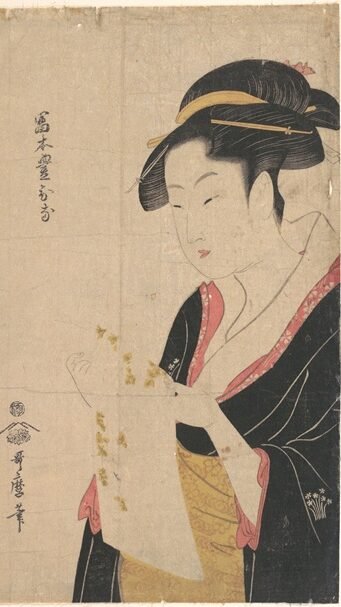


- The Lady Tomimoto Toyohina Reading a Letter. 1790. Toyoshina was one of the three great beauties of Edo (present day Tokyo). She appears in numerous Ukiyo-e prints. She was a Yoshiwara geisha and also a teller of tales in the “Tomimoto-bushi” tradition, a narrator who used the Japanese musical string instrument “shamisen” to tell tales. In this Ukiyo-e she is looking ardently at some flowers drawn on a folded obousho (paper normally used for important messages). Maybe it is a message from a lover?
- Two Beauties with Bamboo. Circa 1795. This shows two women, probably courtesans wearing kimonos with patterns akin to water and bamboos. Elegant and stylish with elongated features and intricate details that emphasise the beauty and grace of the women..
- Okita of the Naniwa-ya Tea-house. 1790s. The subject is Okita, a girl renowned for her beauty working at the Naniwaya tea-house near Asakusa Temple in the city of Edo (present day Tokyo). She was just 15 years old. Everyone had to stop to catch a glimpse of her. Her delicate hands holding the tea cup, her gentle yet refined air, the suggestion of a womanly bump in the neighbourhood of her breasts, these showcase her delicate beauty and grace. A masterpiece by Utamaro.
- The Coquettish type. Edo era in Japan. From the Ukiyo-e series “Ten physiognomic types of women”. This is part of a study by Utamaro of ten types of women. He is saying that he can guess the character of a woman by looking at her face. In particular, the face in this Ukiyo-e pertains to the “Uwaki type”, that is the flirty or coquettish type, women who likes to associate with multiple partners. In the Ukiyo-e, the woman wears a yukata, a loose type of kimono suitable for cooling off after a bath. Her hair is in disarray, her breasts and shoulders are half bare, she is drying her hands and glancing to the side with a slight smile as if looking at a handsome man. The viewer might have experience with this type of woman.
Courtesans (Hanging Rolls)
Ukiyo-e image paintings mounted on “Kakejiku”, Japanese hanging rolls.


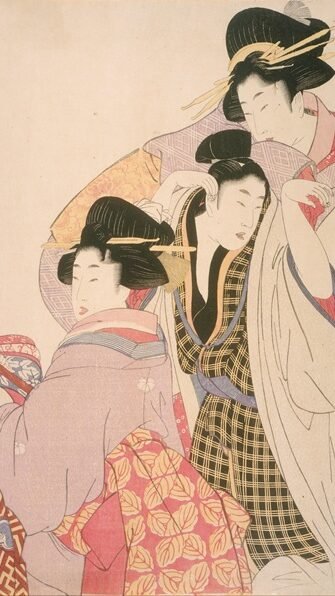
- Standing Prostitute and Kamuro. Circa 1805. This is a glimpse into the elegant world of the Yoshiwara pleasure district in Edo (present day Tokyo). Famous courtesans and their attendants of that period were like modern day celebrities. Personalities to envy. In the center is the standing prostitute or top rank courtesan (oiran). Beautifully dressed, representing beauty and luxury, adorned in elaborate kimonos, hair and makeup. At her side is her attendant, a young girl maybe 10-13 years old, called the Kamuro. She rans errands, assists with the courtesan’s hair or makeup and learns the ropes. Maybe she will be a future Oiran herself. This is moment in the everyday life of a top ranked courtesan of Yoshiwara.
- Courtesan in Procession. This is an “Oiran Dōchū”. A top ranked courtesan (Oiran) is parading in full dress mode in the streets of Yoshiwara. Exquisite kimono, perfect coiffure, a symbol of refined luxury. And she wasn’t just beautiful. She was a master of music, dance, calligraphy, and fashion. This was meant to showcases her beauty,refinement and the prosperity her teahouse to propective customers. The “Oiran Dōchū” is still recreated in present day Japan as a tourist attraction.
- Two Beauties. Between 1791 and 1814. “Two Beauties” was a theme often used in Ukiyo-e of the Edo period. Here, we have a wealthy merchant’s daughter in rich kimono and a seated woman in simple dress that is open to the breast. Both are beautiful but the contrast between rich and simple draws the eye.
- Seated Beauty. Between circa 1800 and circa 1802. A lone courtesan is looking at a piece of poetry wondering what to write. Maybe a client sent her a love poem? A carp woven into her kimono looks at her.
The Indistrious Women of Japan (woodblock prints)



Numbered from left to right.
- Women Preparing Sashimi. 1806-20. Utamaro liked to celebrate a woman’s beauty in all it’s forms. Here we see the beauty of women working diligently preparing Japanese raw fish, the sashimi. Utamaro expanded the scope of bijin-ga, Ukiyo-e prints of beautiful women, by moving from traditional portraits of idealized women and courtesans to beautiful women in the context of ordinary life
- In the Kitchen. 1794–95. This is glance at everyday life in Edo-period Japan. Women are hard at work, preparing a meal in the kitchen. It reflects a trend in 18th century Japan to celebrate the contribution women make to the household. Kitchens were the heart of the Japanese household.
- Hairdresser (Kamiyui). 1797-98. This is from the ukiyo-e series “Twelve types of women’s handicraft (Fujin tewaza juniko)”. This shows Utamaro’s skill in depicting the facial expressions and daily lives of working women in Edo (present day Tokyo). A hairdresser is doing the hair of a patron. The hairdresser has a look of intense concentration, while the patron watches. Basically a scene that can be seen even in the present day. One gets a sense of satisfaction in realizing that a scene that was typical in 18th century Edo (18th century Tokyo) has a counterpart in present day Tokyo.
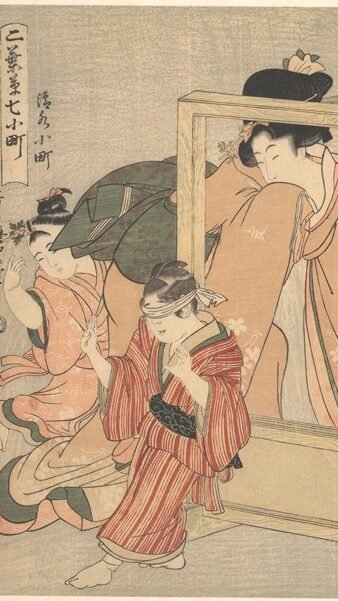
- Kiyomizu Komachi. 1790s. A beautiful woman observing two children playing blindman’s buff. We can see that the children are engrossed in the game while the woman looks on. The genius of Utamaro brings to life a domestic scene that makes us smile. There is another connotation. In the title the word “Komachi” refers to esteemed and beautiful woman. Once upon a time in 9th century Japan there was an ancient poet celebrated for her literary talent and beauty. Her name was Ono no Komachi. “Komachi” harks back to her. So this is a domestic scene where an esteemed and beautiful woman is looking after two children.
- Young MotHer Nursing Her Baby. A young woman is giving milk to her baby. There is a look of intense concentration on her face attesting to a mother’s love for her child. Her flowing kimono symbolizes grace and maternal warmth. The Japanese characters on the upper right says “Fūryū Nana Komachi”, which indicates the mother in this Ukiyo-e is one of “the seven poetic beauties of antiquity”.
Picture Book of Insects
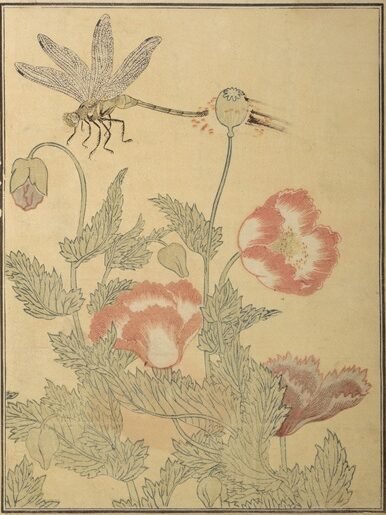
Utamaro was famous for his “picture book of insects”. He was not just a Bijin-ga (Ukiyo-e featuring beautiful women) artist. Click the images below to scroll view his amazingly detailed depiction of insects. There is a butterfy, a dragonfly and a grasshopper. They are shown among flowers and grass, attesting to Utamaro’s love of nature. The insects were common in Japanese cities in the 18th century, but not so common nowadays due to over industrialization.



_-_from_the_series_%27Twelve_types_of_women%27s_handicraft_(Fujin_tewaza_juniko)%27_-_Google_Art_Project.jpg)
;_Locust_(Inago),_from_the_Picture_Book_of_Crawling_Creatures_(Ehon_mushi_erami)_MET_DP135556.jpg?uselang=ja)
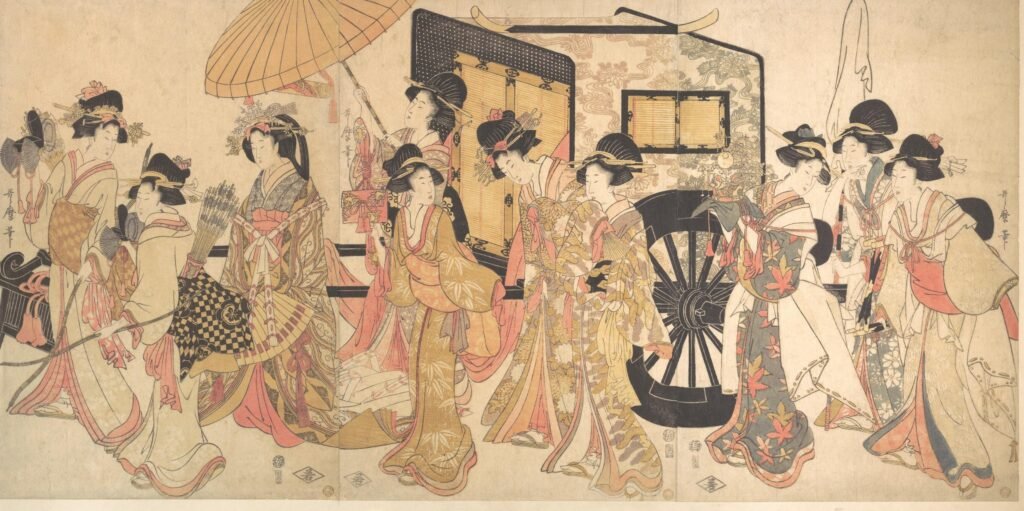
Beautiful Mock Court Procession staged by Courtesans
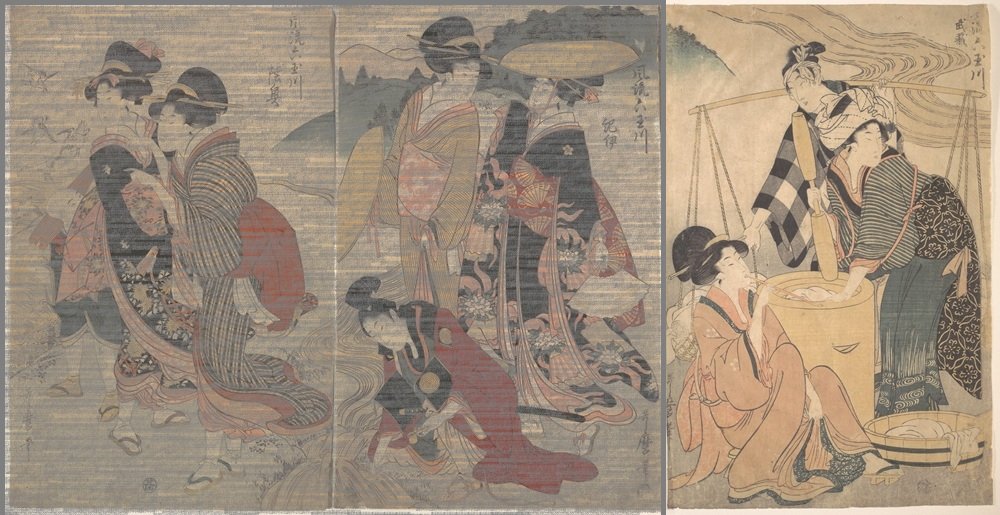
A court procession in the Edo era in Japan, probably meant the “sankin kōtai”. This is a political system where feudal lords were forced to travel to the capital city of Edo every few years to spend time with family and wife. The lords were expected to travel in great style in massive, expensive parades which included servants and samurais. Family and wife were hostages. This was a great expence for the lords robbing them of resources needed to rebel against the ruling Tokugawa family. In this Ukiyo-e the parade is a mock parade staged by beautiful courtisans. The Ukiyo-e here is a triptych of woodblock prints, three Ukiyo-e prints make up a series of three.
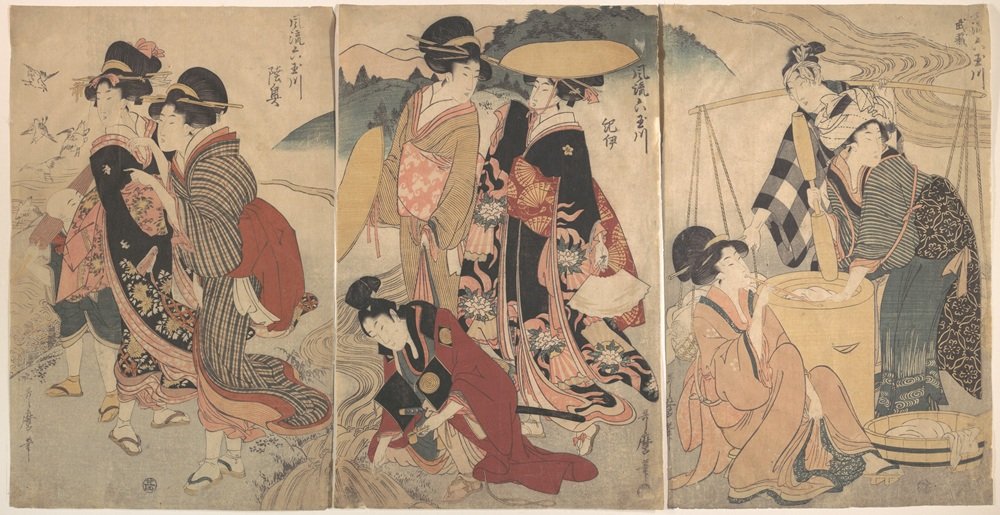
The Elegant river Spot Series: Musashi, Kii & Mutsu
風流六玉川 武蔵 紀伊 陸奥
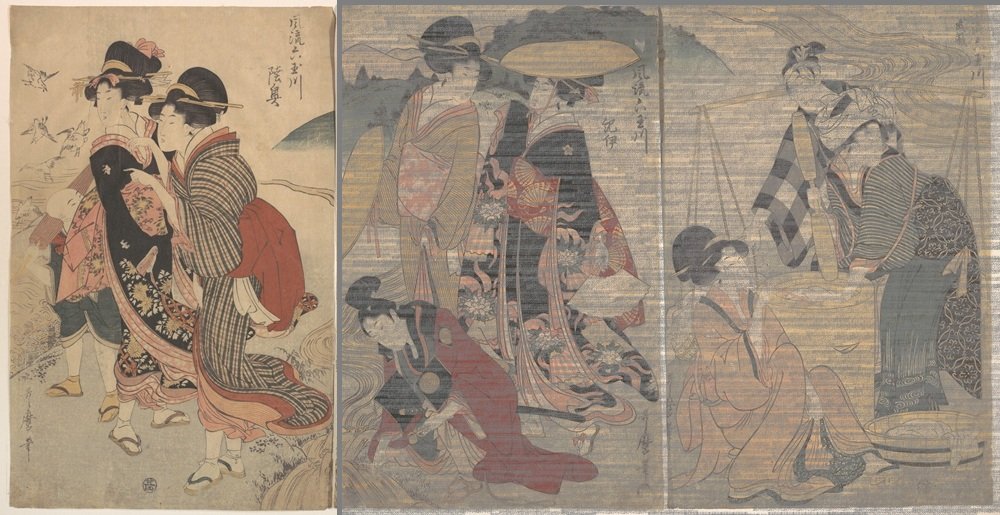
Musashi Province
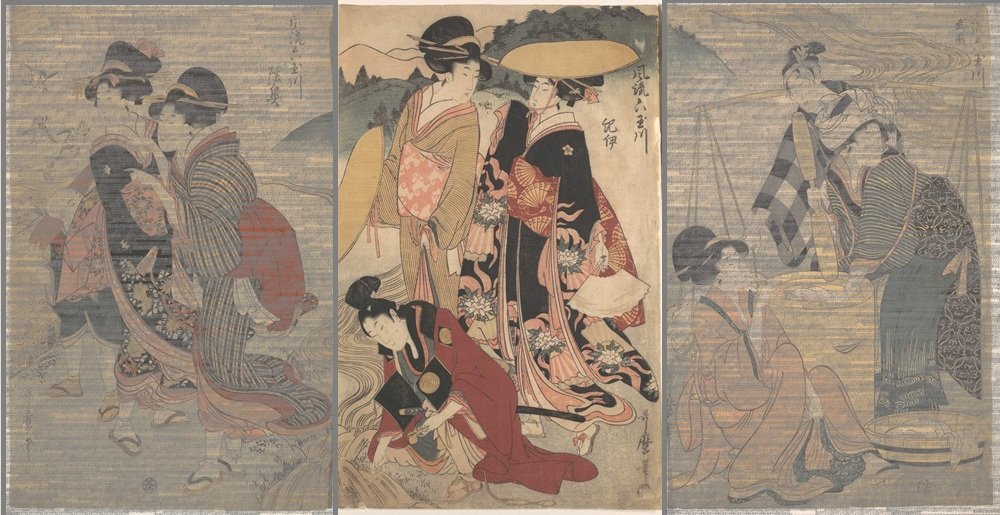
Kii Province
Mutsu Province
The elegant river spot series is a triptych of woodblock prints, three Ukiyo-e prints make up the series.
About Kitagawa Utamaro


.jpg?uselang=ja)

About Kitagawa Utamaro
Kitagawa Utamaro (?–1806) was a renowned Japanese artist of Ukiyo-e woodblock prints and paintings. His contribution to the Ukiyo-e world was the introduction of bijin ōkubi-e “pictures of beautiful women from the waist up”. He was also famous for his nature studies, particularly his exquisitely detailed book of insects. It is not known where he was born but his childhood teacher was Sekien, a Japanese painter of the upper-class Kanō school who later became a Ukiyo-e artist. In the beginning, Utamaro worked as an illustrator of popular literature, but in 1782 met a young publisher named Tsutaya Jūzaburō and started working with him. This was crucial. A Ukiyo-e woodblok print needs an artist to provide the original design, a carver to carve wood, an inker, a printer to press ink onto the paper. If the print is multi colored, multiple woodblocks have to be carved. With the coorperation of Tsutaya, the finest woodblock printing team could be assembled. Tsutaya would become a major publisher in his own right.
In the 1790s Utamaro reinvented himself. He distanced himself from illustrations and concentrated on making single portraits of women displayed from the waist up (bijin ōkubi-e). This was a break from tradition in that previous Ukiyo-e artists had concentrated on prints of women in groups. This focus on the upper body made the woman’s face more prominent. Utamaro could take advantage to capture the inner beauty and personalities of the woman. This was a success and he became a recognized artist. He made a series of well-known works, featuring women in the Yoshiwara district.
Utamaro was imprisonned by the authorities for producing politically sensitive Ukiyo-e in 1804 and died in 1806. In sum, he was the pre-eminent Ukiyo-e artist in the 1790s and left over 2000 known prints. Utamaro’s work reached Europe in th 1880s and influenced European painters such as Monet, Degas and Gauguin.
What is a top rank courtesan (oiran) ?
The term oiran originated in Yoshiwara, the red light district of Edo (present day Tokyo) in the 1750s. It refered to top rank courtesans. They were considered to be above common prostitutes who were known as yūjo which meant “woman of pleasure” in Japanese. An oiran had to be beautiful and also have traditional entertainment skills such as singing, classical dancing and playing music with the koto and shamisen. They were the leaders of fashion. Many oiran became celebrities both inside and outside of the pleasure quarters. They were often depicted in Ukiyo-e woodblock prints.However they were also often from improvished low class families and were indentured to an establishment. The only way to be free from an establishment was for a wealthy client to buy their indenture. This did not happen often. An oiran in the traditional sense does not exist now. Prostitution was outlawed in Japan in 1957.
Notes
The comments above reflect only the thoughts the administrator had while viewing the images. They might or might not be comments by the artist, subjects or the photographers etc.. Please excuse any inaccuracies. You are welcome to leave comments in the comment space. Otherwise send messages to “kohi@scroll.kohibiz.com”.
Click the underlined titles. This will link you to the original site from which the images were taken. We believe there is no problem with the image license. Most are in the public domain.
The images are from Wikimedia Commons or Art Institute of Chicago or The Met. If there are any problems please leave a message. Images will be taken down if necessary. Some images have been cropped from the original using the Vertical Scroller application program. This is to ensure the best viewing experience.