This post is a series of images featuring great female forms in art of the 18,19th century art. Mankind has always celebrated beautiful women and you will find that this is true through all ages, particularly the 18th and 19th century. Enjoy !
This site attempts to make apparent the beauty hidden in images thru the site’s image scrolling function. This post in particular is a selection of images of lovely women paintings in the 18th or 19th century. Find the beauty concealed in the paintings !
Choose an image, It will expand and scroll view. You can click control tabs on the upper left corner of the screen. Depending on the tab, you can (1)fast scroll (skip button), (2)expand, (3)minimize, (4)shift right or left, (5)pause or (6)scroll up or down. You will see details not noticed in normal viewing. This will reveal beauty hidden from you before. Enjoy !
Female forms in the Paintings of Lefebvre
The following are by French painter Jules Lefebvre. Lefebvre was born in Seine-et-Marne, France on March 1836. He entered the École nationale supérieure des Beaux-Arts in 1852 and won the Prix de Rome in 1861. In 1870 he was awarded the Légion d’honneur and became Académie Julian professor. In 1891, he became a member of the French Académie des Beaux-Arts. He died in Paris on February 1911. His fame as a painter resides mainly in his beautiful depiction of nudes inspired by allegorical, literary or mythological figures. Below are samples of his art.
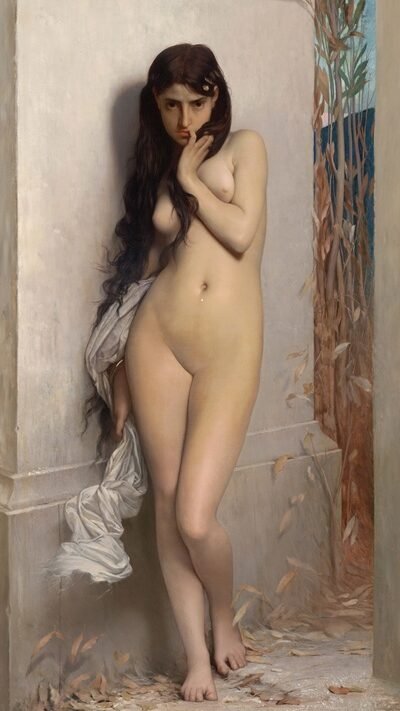


Numbered from left to right.
- La Cigale (the grasshopper) 1872: This is one of Lefebvre’s classic female nudes. It was inspired by a famous fable by Jean de La Fontaine, ‘The Ant and the Grasshopper’. You might have heard of it. In the fable, the grasshopper spends summer singing and playing while the ant works hard to store food for the winter. Winter comes and the grasshopper freezes, homeless. Poor girl, beauty is not enough, you have to work hard.
- Pandora 1872 : This was inspired by “Pandora” in Greek mythology. Pandora is the “First” woman. She was created by the gods and had a jar. She was told not to open it but curiosity overcame her and she opened it releasing sickness, death, suffering; in fact all the evil in the world today. Innocent woman, heed the gods. In the painting a box is shown but this is a common mistake. in the myth it is a jar.
- Truth 1870 : This was a great success and lead to Lefebvre receiving the Légion d’honneur, the highest national distinction awarded by France. This is a painting of an idealized woman, nude, sexy, holding a shining mirror over her head which represents “truth”. This is the timeless woman. But actually the woman is Sophie Alexandrine Croizette, a well known French actress and viewers of that time would have recognized her face. An idealized woman with a recognizable face.
- Ondine 1882 : Ondine is a figure in mythology and different versions of the story exist. Basically Ondine is a water nymph who gains a soul by marrying a man. But if the man is unfaithful, a curse manifests. In one version he dies. This was a popular motif in the 18,19th century and many paintings exist. John William Waterhouse, Paul Gauguin, Carl Wilhelmson each have their own interpretation. In the case of Lefebvre, Ondine is a red headed beuty with a perfect classical body and white skin that seem to glow. Virginal, pure yet sensual.


Female Forms By Jean-Léon Gérôme
The paintings are by master academic painter Jean-Léon Gérôme (1824–1904). Gerome was born in Vesoul, Haute-Saône, France and learned drawing under teacher Claude-Basile Cariage. He showed talent and when he was 16, he went to Paris to study under Paul Delaroche a successful French painter of historical scenes. In1843 he accompanied Delaroche to Italy, Florence, Rome and Pompeii. In 1844, he returned to Paris, joined the atelier of Charles Gleyre an associate of Delaroche, then attended the École des Beaux-Arts. In 1846, he tried for the prestigious Prix de Rome but failed. However his painting “The Cock Fight (1846)” was well received. He built upon this producing excellent paintings such as “The Virgin”, “Bacchus and Eros” etc..
In 1856 he visited Egypt for the first time. Up the Nile river to Cairo, Faiyum and the Abu Simbel Temple. Back to Cairo, then up the Wadi el-Araba to Jerusalem and Damascus. It was a typical tour of the orient and lead to his Orientalist paintings.
When he returned, in the Paris Salon of 1857 he exhibited on Oriental themes. This greatly enhanced his reputation. From then on he painted in both Classical and Oriental styles.
On the professional side, he was appointed professor at the École des Beaux-Arts and between 1864 and 1904 taught at the École des Beaux-Arts. it is said he had more than 2000 students.
He was showered with awards and honors. In 1865 he became member of the Institut de France. In 1869, he was elected honorary member of the British Royal Academy, the King of Prussia awarded him the Grand Order of the Red Eagle, the Society of French Orientalist Painters named him honorary president and in 1895 he became International Member of the American Philosophical Society.
However, in the later part of his career, Impressionism became popular. Impressionism with it’s emphasys on capturing the visual impression of a scene subjectively, the effects of light and color, working outdoors to directly depict the changing qualities of light and atmosphere, painting everyday themes was the direct opposite of Gerome’s paintings. Gerome painted in the studio, focused on historic or mythical themes. Gerome staunchly defended the academic style but it fell out of favor.
On the family and/or commercial side, in 1863 he married Marie Goupil and had five children. Marie was the daughter of one of the greatest art dealers of that time Adolphe Goupil. Technology was coming to the art world and a system of mass reproduction – first engraving then photography – started. Gérôme and Goupil took advantage. Works that could be exhibited only briefly at the Salon could be mass-produced. sold and circulated worldwide, reaching new audiences. This brought both fame and profit to artist and art dealer. The famous novelist Emile Zola pointed out, “Clearly Monsieur Gérôme works for the House of Goupil. He makes a painting so that it can be reproduced through photographs and engravings and sold in thousands of copies.” Our present day pre-conceptions of the Orient, the harems and concubines owe much to Gerome’s Oriental paintings and reproductions thereof.
Gerome died on 10 January 1904, The Requiem Mass given in his memory was attended by multiple politicians, painters and writers. He was buried in the Montmartre Cemetery.
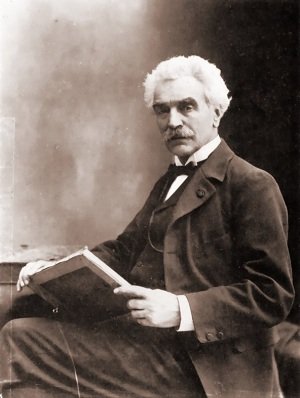
Jean-Léon Gérôme
(1824-1904)

Wife “Marie Goupil”
(1841-1912)
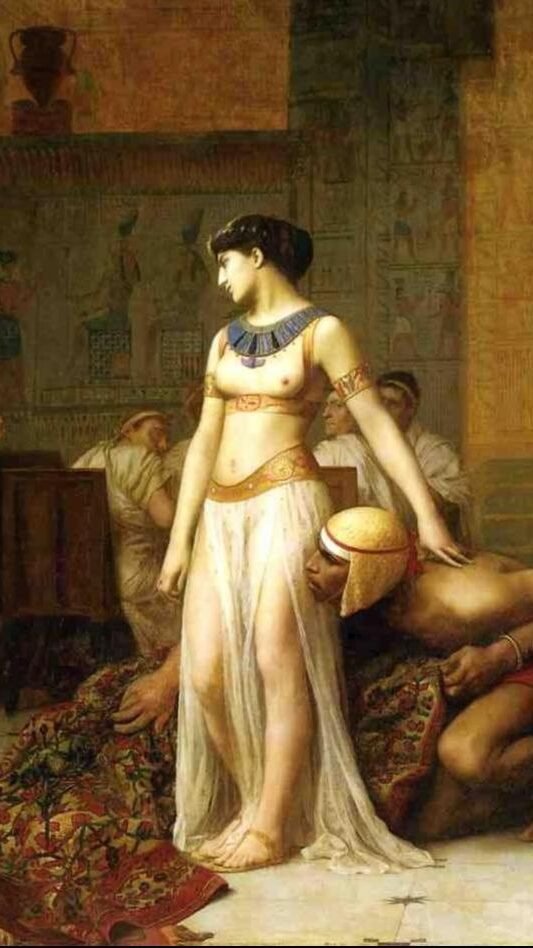


Numbered from left to right.
- Cleopatra and Caesar 1866: This scene is based on a writing by Greek historian Plutarch (c. AD 46 – AD 120) “Life of Caesar” and is an early depiction of Cleopatra emerging from a carpet in the presence of Julius Caesar. It was mass-produced by Gérôme’s father in law, famous art dealer Adolphe Goupil and propogated worldwide. Gérôme was famous for historical accuracy and we see this in the costumes that Cleaopatra wears, the Egyptian headdress and flowing garments and Caesar’s Roman style military robe. The architectural backdrop of ancient Egypt in the painting is thought to have been inspired by “Description de l’Égypte“, a series of publications about Egypt that ran from 1809 to 1829 where an image of a temple at Deir el-Medina was presented. This attention to historic veracity transports the viewer to the world of ancient Egypt and Rome. The painting shows a significant moment in history where Cleopatra, last ruler of the Kingdom of Egypt, meets Julius Caesar, the Roman general and statesman. Multiple nuances are present. (1) This was a love meeting between a beautiful woman and a powerful man. Cleaopatra looks resplendent in her Egyptian dress, confident, bold, resourceful. She had just smuggled herself into Caesar’s room hiding herself in a carpet. Caesar is startled to see her beauty and intrigued. (2) This was also a political meeting. Cleopatra asked Caesar for help in consolidating the throne of Egypt. Caesar wanted the alliance to extend his influence in the Mediterranean and get a foothold in Egypt. (3) This was a meeting of two worlds. Ancient Egypt versus the new Roman empire. This can be seen in the contrast between the Egyptian wall paintings, Cleopatra’s flowing Egyptian dress and Caesar’s military Roman garb.
- The Slave Market 1866 : This is an iconic example of 19th-century orientalist art. Gérôme’s father in law Adolphe Goupil bought and exhibited it at the Salon in 1867. The painting depicts an unknown Oriental open air slave market where a man inspects the teeth of a nude, white female slave. The woman seems resigned to the humiliation and exudes an air of passive sexuality, while the men ogling her seem violent and uncouth. This supposedly symbolizes a meeting of West and Arab where Arabian men seek to subjugate Western women. This is one of the stereotypes that 19th century Europe had about Arabia. The painting has impact even now. In 2019, the political party Alternative for Germany(AfG) used this painting in the European Parliament election to protest illegal immigration related to Syrian refugees . It was coupled with the slogan “Europeans vote AfD!”, “So Europe doesn’t become Eurabia!”. Gérôme must have been aware of the connotations of the painting, but it is doubtful Gérôme ever saw a real slave market. Open air slave markets were a thing of the past in the 19th century. But Gérôme’s painting was so good it influenced European thoughts about the Arab even though it was probably something from Gérôme’s head.
- Moorish Bath 1870 :This reflects Gérôme’s take on an Eastern bath, featuring a nude woman, Circassian or Middle Eastern descent, attended by an African woman and embodies the way the West viewed Eastern culture. It is doubtful Gerome ever saw this scene. It is said to be a product of his imagination which sprung from the numerous notes, photos and souvenirs he accumulated in his travels to the orient. These lent a aura of authenticity to his paintings fascinating his viewers.
- A Roman Slave Market 1884 : A lovely woman is depicted being auctioned off at a slave market in ancient Rome. Some men are leering at the sensuality of her nude body. This painting highlights the harsh reality and human suffering in a Roman slave market. The inhumanity, the contrast between the power of the auctioner and the lowly slave. It is a typical Gerome painting, drawing on the Neoclassic and/or Romantic style. The historical setting “Roman Slave Market” gives reality to the scene.


The Fantastic women of Falero
Luis Ricardo Falero (1851–1896) was a Spanish painter who settled in London and specialized in female nudes in fantastic, mythological or oriental settings. He was born in Granada, Spain to well to do parents who hoped he would pursue a career in the Navy. However at the age of 16, he set off to Paris to study chemistry, engineering and art. He exhibited at the Paris Salon from 1878 to 1885 but in 1887 he moved to London and dedicated himself to the arts. There he became an established painter. He died when he was 45. His paintings featuring beautiful witches, nude fairies, nymphs and oriental beauties are popular even today. Falero’s painting “The Sorceress” was sold at Sotheby’s auction in 2008 for 167 thousand dollars.
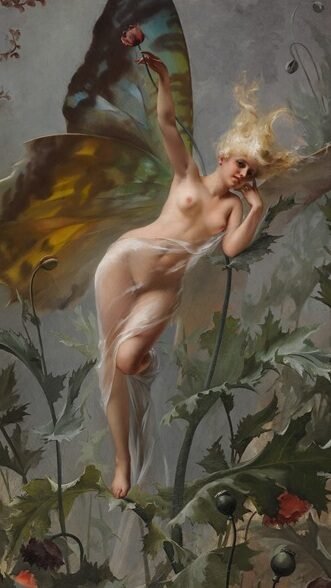


Numbered from left to right.
- Poppy Fairy 1888: A beautiful young woman embodying the winged “Poppy Fairy” flies in the air among some dark folliage. The woman’s pale skin glows in the surrounding darkness and accentuates the perfection of her otherworldly form. She smiles slightly. This is a moment of tranquility and contentment. A moment of transformation and rebirth, a time to reafirm the fleeting joys of life. This painting shows Falero was a master of the academic school, painting with great anatomical accuracy, imbuing his work with realistic and allegorical nuances typical of 19th century academic art.
- Witches on the Sabbath 1878: The Witches’ Sabbath, in folklore, is a nocturnal gathering of people who practice witchcraft. It was a time to consort with the devil, do black magic and rituals including sexual acts and human sacrifice. This became popular in medieval times as Christianity took hold of Europe. Women with their carnal desires were supposed to be particularly susceptible to the devil and were often victimized. Wild stories of girl witches emerged. In Falero’s painting we glimpse the fascination the 19th century audience had for all this. The central figure is a lustful woman staring at us on a black goat, the goat being an incarnation of the devil. Below we see an old crone reaching and caressing the butt of a woman who clutches a man. A dark erotic scene which is also beautiful. It is Falero’s superb handling of the female form that imbues this painting with beauty.
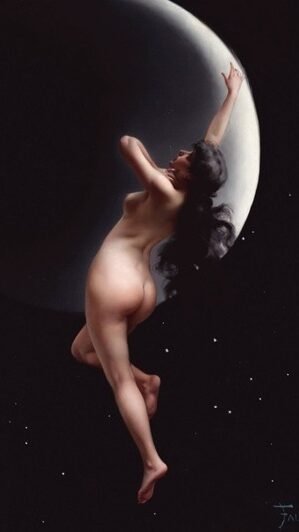
- Moon Nymph 1883: This is a well known painting by Falero and depicts a moon nymph, a minor nature deity in Greek mythology, specifically associated with the moon. Nymphs had beautiful, ethereal figures and wraithlike forms. Falero surrounds the pale beautiful womanly form with the darkness of night and illumination from the moon. This brings focus to the woman. A masterpiece in the academic style of the 19th century.
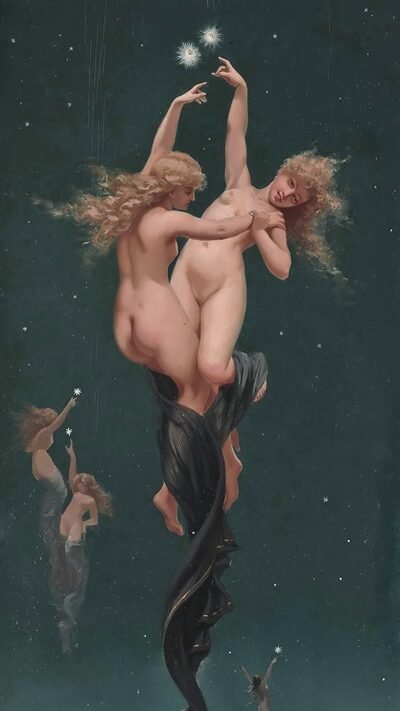
- Twin Star 19th century: Falero was interested in astronomy and often included celestial constellations in his work. This is such a painting. It depicts two beautiful female forms, celestial beings, entwined against a backdrop of stars. Their pale skin shine in the darkness of the night sky. They are beautiful. Other twin female forms are present, emphasizing the fact that the cosmos is infinite. This mirrors Falero’s fascination with the interplay of light, beauty, and the supernatural, the sense of wonder he must have felt in the exploration of the cosmos.
- Dawn 1883: This lovely woman symbolizes dawn, the break of day. This can be classed as a typical allegorical painting in 19th century European style.
.jpg)


Simply A Celebration of womanly beauty



Numbered from left to right.
- Tepidarium 1853 : This is a painting by Théodore Chassériau (1819–1856). He was born in El Limón, Samaná, in the Spanish colony of what is now the Dominican Republic. In 1820 his family left the Dominican Republic for Paris. At the age of 11 he showed such talent he was accepted into the studio of the great French Neoclassical painter, Jean-Auguste-Dominique Ingres. He was one of Ingres’ best pupils. In 1840 Chassériau travelled to Pompeii and this inspired “Tepidarium” which was painted in 1853. A tepidarium is a warm room in ancient Roman bathhouses, not as hot as the bathroom proper but moderately hot, used to relax and socialize. This painting depicts some women relaxing after bathing in the tepidarium. The painting seems to focus on the personal interplay between the women. Chassériau was a pupil of Ingres but he tried to combine aspects of Ingres’ classical realism with Romanticim, Romanticism contrasted with Ingres’ Neoclassical aproach in that it emphasized emotion over reason, placed personal genius and heroism over strict adherence to rules and procedures. Also Romanticism was lead by the Eugène Delacroix, Ingres’ rival and this lead to a break between tutor and pupil. However the Chassériau’s art was superb and his legacy lives on. There is a Society for the painter: “Association des Amis de Théodore Chassériau”, which persists even today.
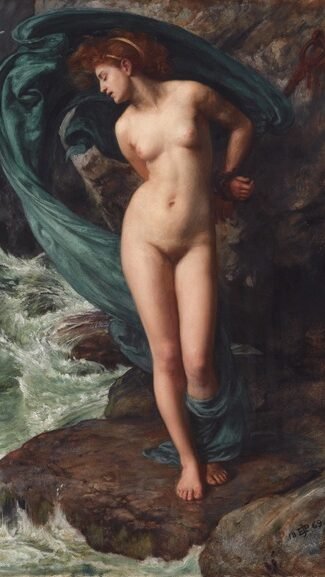
- Andromeda 1869 : This was painted by English Neoclassical painter Sir Edward John Poynter (1836 – 1919). He had an illustrious carreer; Slade Professor at University College London from 1871 to 1875, principal of the National Art Training School from 1875 to 1881 and director of the National Gallery from 1894 to 1904 where he oversaw the opening of the famous Tate Gallery in London, full Royal Academician in 1876, President of the Academy in 1896. As a painter he was famous for his historical and/or mythological works. The painting above “Andromeda” was created in 1869 and depicts the mythological Andromeda chained to a rock as a sacrifice. It is an example of Poynter’s work in the Victorian Neoclassical style.
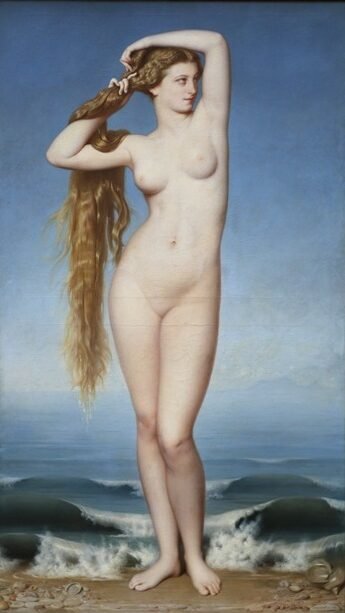
- Birth of Venus 1862 : This is by Eugène Emmanuel Amaury Duval (1808–1885), a French academic painter, pupil of the celebrated Neoclassical painter Jean Auguste Dominique Ingres. It depicts the goddess of love and beauty Venus arriving on the island of Cyprus after her birth. It is thought to be inspired by Ingres’s painting “The Source” and emphasizes the beauty and eroticism of the female form. It exposes a woman’s private parts and is thus a departure from classical norms such as Botticelli’s Venus where a woman’s parts were hidden by long hair. There were some semi-negative criticism at the time it was anounced; critic Albert Guillemot for example commented that while the model was fine, the drawing pure, the color was pale and thin and overall, there reigned a somewhat unhealthy, but distinguished grace. This was a typical reaction towards Ingres or Ingres like paintings at that time.
- A nude woman doing her hair before a mirror 1841 :The painter is Christoffer Wilhelm Eckersberg (1783 – 1853), the “Father of Danish painting”. He was born in Aabenraa Municipality, Denmark. He began training and became an apprentice in 1800. In 1803 he was accepted into the Royal Danish Academy of Art, painting historical paintings, portraits and landscapes. He won the Academy’s big gold medal in 1809. He studied under the famous neoclassicist Jacques-Louis David from 1811 to 1812. In 1816, he returned to Denmark and became a member of the Academy in 1817. He was named professor in 1818 and was director of the Academy from 1827 to 1829. He died in Copenhagen on 22 July 1853. The painting above is regarded as one of the masterpieces of the Danish Golden Age. It depicts a woman, back turned. It is a beautiful intimate scene. The woman is not aware that she is being watched. It is like we are peeking through a keyhole at the woman. This painting led the way to the characteristic manner Danish Golden Age painters often portrayed women. That is scenes of women in common everyday life. Some have discussed it’s similarities with “La Grande Baigneuse (1808)” by Jean Auguste Dominique Ingres. They both studied under Jacques-Louis David so this is a possibility.
- Study of a nude woman : This is a painting by Wojciech Korneli Stattler (1800 – 1875), a Polish Romantic painter. Stattler was born in Kraków, Poland, son of city councilor Joachim Stattler. At first he studied mathmatics and science but later attended the drawing class of the School of Fine Arts. In 1818–27 he went to Italy, continuing his art studies. Upon returning, Stattler was appointed Professor of the School of Fine Arts in Kraków, where he started dramatic changes, introducing live model studies as well as nude art models. He left Kraków for Warsaw around 1870 and died on 6 November 1875.


Muted Female Forms (The Japanese Ukiyo-e)
Beautiful female forms seen through the lens of Japanese art. Delicate, muted yet sensual.


- “Hinagata wakana no hatsu moyō” (New designs as fresh as young leaves) between 1764 and 1788 : The author is Isoda Koryūsai (1735–1790). He was famous for his “Bijinga (Ukiyo-e of beautiful women)” . His role-model was Suzuki Harunobu credited to be the first to produce nishiki-e, a type of Uliyo-e featuring multicolored woodblock prints. After Harunobu’s death, he came to be regarded as the successsor but was eclipsed by Kiyonaga another famous Ukiyo-e artist. However some say that he may have been the most productive Ukiyo-e artist of the 18th century.
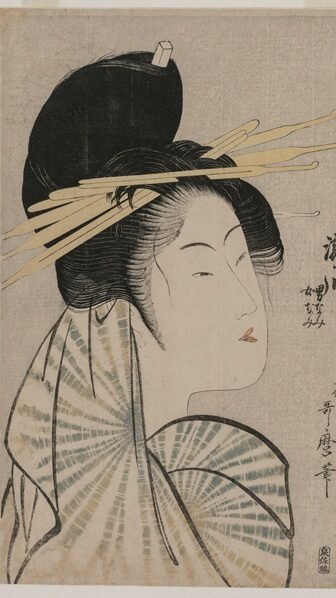
- The Courtesan Takigawa of Ogiya 1797 or 1798 : The subject of the Ukiyo-e above was Takigawa a renowned courtesan at the Ogiya brothel in Tokyo and and is depicted cooling off after her bath. The author is Kitagawa Utamaro (1753 – 1806). He was one of the best Ukiyo-e artists, specializing in Bikinga (Ukiyo-e featuring beautiful women) and is regarded as the successor to Kiyonaga. It is said Utamaro was nationaly famous when other established Ukiyo-e masters were relatively unknown outside Tokyo. Internationaly a wave of interest in Japanese art called Japonism swept Europe in the 18th century and an Utamaro exhibition was staged. It is said that Impressionist artists such as Monet, Gauguin, Degas and Mary Cassatt who was Degas’ friend studied his works.
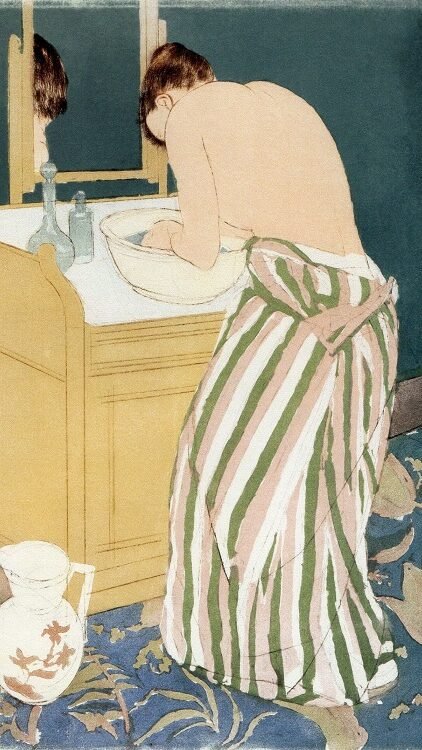
- Woman Bathing between 1890 and 1891 : This work is by Mary Cassatt (1844–1926). She was born in the US but lived for long periods in France. She was a precocious talent. In 1855 when she was 11, she attended the Paris World’s Fair and viewed the works of famous academic artists such as Jean Auguste Dominique Ingres, Eugène Delacroix and Gustave Courbet. In 1866 she made a big decision and moved to Paris to study, but it was not yet a woman’s world. She found she could not attend the École des Beaux-Arts because of her gender. so she studied privately with renowned academic masters such as Jean-Léon Gérôme. She also exhibited at the Salon. The art world was changing, moving from the academic style to new styles such as Impressionism. She was one of only two women to join the Impressionist group in 1877 and exhibited at the 1879 Impressionist show. However she drifted away, concentrating on intimate scenes from daily life that involved women. As a woman, she had a unique perspective that none of her male colleagues could match. In 1891, she exhibited highly original colored drypoint and aquatint prints, such as “Woman Bathing” (above) that demonstrated her close study of Japanese color woodblock prints. This was inspired by Japanese art shown in Paris the year before. It is an intimate scene of a woman’s daily life with color, composition and shape similar to choices made by Japanese masters such as Utagawa Hiroshige. Cassatt probably liked the simplicity and clarity and skillful use of blocks of color. She died in 1926. She had had training as an academic painter, moved to Impressionism then to modern art. She is regarded as a bridge between impressionism and modern art. Posthumously in 1955 she was awarded the highest French national order of merit, France’s Legion d’honneur.
- “Yokugo no onna” (woman after a bath) 1915 : The author is Goyō Hashiguchi (1880–1921). He was a 20th century Ukiyo-e master. A member of shin-hanga (“new prints”) movement, a revival of ukiyo-e. He died early and designed only 14 woodblock prints but they are regarded as masterpieces. The model for this work is Tomi who was a favourite of Goyo’s. It is a delicate and graceful portrayal of Tomi, exquisite in it’s sensitivity to a woman’s beauty.


_Yokugo_no_onna_(cropped_and_compressed)_01.jpg)
Notes
The comments above reflect only the thoughts the administrator had while viewing the images. They might or might not be comments by the artist, subjects or the photographers etc.. Please excuse any inaccuracies. You are welcome to leave comments in the comment space. Otherwise send messages to “kohi@scroll.kohibiz.com”.
Click the underlined titles. This will link you to the original site from which the images were taken. We believe there is no problem with the image license. Most are in the public domain.
The images are from Wikimedia Commons. If there are any problems please leave a message. Images will be taken down if necessary. Some images have been cropped from the original using the Vertical Scroller application program. This is to ensure the best viewing experience.